

The honeymoon may be just beginning to sour. It will be some 100 years since the Saudis stood up from their camel-dung-strewn tents to welcome the suited Americans and sell them their desert oily country in exchange for protection against a threat that never existed.
In fact, the threat was not against the Saudis as much as it was against America from Saudi Arabia itself ruled by the radical ultra-religious Wahhabis who, once the dollars started coming from American-pumped oil from their deserts, thought they were on top of the world. Just as Americans are over-confident in their white Christian greatness and uniqueness, Saudis are super-proud of their Islamist supremacist nationalism.
With their oil dollars, and having discovered how dumb the otherwise tech savvy Americans really were, the Saudis started a campaign to Islamize the West. Preachers were dispatched to every western capital, mosques were built by the thousands, and money flowed into the hands of every illuminated Muslim who was willing to do just about anything to get a ticket to Heaven. The convulsions striking the entire western world today due to the Islamist threat find their etiology in Saudi Arabia itself.
To save face at being dependent on Americans for protecting them against hypothetical scarecrows, the Saudis decided to put some bone into their cartilaginous spines. They started purchasing weapons from the Americans by the hundred of billions of dollars. This way, they'll appear to be tough without really being tough. The savage Zionists at the time did not see Iran as a threat to their Colonial Chosen Homeland in Palestine; it was the Sunni Muslim Saudis who posed the threat. So, the Zionist lobby in DC always opposed any sale of serious weapons to the Saudis. What if, they argued, even more radical Islamists took over in Riyadh and turned these weapons against the Zionist rapists of Palestine?
America agreed with the Zionists but did not want to upset the Saudis lest they do another oil embargo like the 1973 one. Therefore another scarecrow had to be erected to terrify the Saudis into submission, and that was the Islamic Theocracy in Iran which, since 1979, has been brandished to scare the Saudis and the other Gulf penguins. Today's American war on Iran is the culmination of that policy.
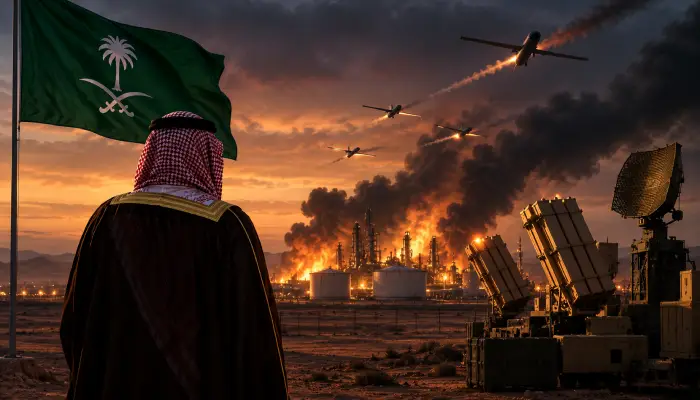
Now, the Saudis keep buying weapons by the hundreds of billions of dollars from the US which essentially is a sneaky way for the Americans to recoup the money they spend extracting Saudi oil. But the problem really is that all these weapons purchases are futile because the Saudis haven't yet learned to be technologically and militarily independent. They buy the weapons but have the Americans maintain them and use them. The F-35s now pounding Yemen are not piloted by Saudis; they are piloted by Americans. Just like the Zionist colony in Palestine, Saudi Arabia is no more than an American military base in the region.
After the AFP report below on the latest sale of US weapons to Saudi Arabia, make sure to read the analysis that follows entitled "Producing one’s own Defense or consuming the Defense of others? The Saudi Paradox...". The Zionist colony in Palestine is jealous of Saudi Arabia because they both compete for Washington's love and attention, which is why the Zionist colony continues to oppose weapons sales to the Saudis even as it is begging the Saudis to recognize its existence and "normalize" with it. In fact, the US concurrently approved arms sales to both Israel and Saudi Arabia just so its bastard sibling protégés do not fight with one another. But how long before a Greek tragedy strikes this ménage à trois whose protagonists have really little in common.
US approves sale of 48 F-35 jets to Saudi Arabia
W.G. DUNLOP
Fri, September 18, 2026
A Lockheed Martin F-35 Lightning II is flown as part of a display on the opening day of the Farnborough International Airshow 2026 (Toby Shepheard)
The United States has approved a $24.3 billion sale of 48 F-35 stealth warplanes to Saudi Arabia, the State Department said Thursday, the kingdom's latest major arms purchase since the start of the Iran war.
Saudi Arabia has long sought to buy F-35s, but officials from Israel -- currently the only country in the Middle East to operate the jets -- has voiced concern about their sale to Riyadh despite a push for the kingdom to normalize relations.
"The proposed sale will improve Saudi Arabia's capability to deter current and future threats by strengthening its homeland defense, and improving interoperability with US forces," the State Department said in a statement.
It "will also augment Saudi Arabia's operational aircraft and enhance its air-to-air, and air-to-ground self-defense capability," the statement said.
The Saudi embassy in Washington praised the transaction, saying it "reflects the strength and enduring nature" of the relationship with the United States.
It added that the security cooperation between the two countries "has contributed to regional stability, strengthened our collective defense capabilities, and advanced our shared security interests."
Saudi Arabia has been repeatedly targeted with drone and missile strikes by Tehran's forces since the United States and Israel launched their war against Iran in February, and has also been hit by Yemen's Iran-backed Houthi rebels.
Yemen's civil war had been dormant for years, but fighting between Houthis and the internationally recognized, Riyadh-backed government reignited in July, with the rebels declaring a maritime blockade of Saudi Arabia and targeting its ships in the Red Sea.
Washington has not directly entered the conflict, but a US official said earlier this week that an American military task force is working to enhance intelligence sharing and planning assistance for Saudi forces.
- Congressional approval pending -
The State Department has notified Congress about the proposed sale, which would require the approval of US lawmakers. It did not provide a time frame for the delivery of the jets.
The F-35 sale "will not alter the military balance in the region," the State Department said, in keeping with longstanding US policy that Israel must have a military edge over potential regional adversaries.
The United States has so far only allowed the sales of F-35s to its closest allies, including a number of European NATO allies and Israel.
Washington kicked NATO member Turkey out of the F-35 program in 2019 because Ankara's purchase of a Russian air defense system sparked fears that Moscow could acquire the plane's technology.
- Billions in arms sales -
Washington also has concerns about potential Chinese espionage related to the jets.
The New York Times reported this week that US intelligence analysts have raised the possibility that Beijing could acquire F-35 technology through its partnerships with Riyadh.
US Representative Raja Krishnamoorthi, a Democratic member of the House Intelligence Committee, expressed opposition to the sale on those grounds.
It should not go ahead "when our own intelligence community is warning that it could put the crown jewels of American military technology within reach of the Chinese Communist Party," Krishnamoorthi said in a statement.
The F-35 sale is the latest in a series of major arms buys by Saudi Arabia this year.
The State Department announced the approval of a $5 billion sale of more than 10,000 bombs -- including highly destructive 2,000-pound weapons -- to Riyadh earlier in September.
Washington also signed off on the sale of 60 tank engines and related equipment to Saudi Arabia at a cost of $750 million this month, and a $1.96 billion deal in July for the kingdom to buy guidance sections that can convert rockets into precision weapons.
wd/pnb/jgc
When one does not want to, as in our case in Lebanon, or when one is unable to, as in the case of Saudi Arabia, assume the cost of one’s own Defense and Security, sooner or later one ends up paying the price, often tenfold.
For the Security that a state entirely delegates to a foreign power is never an all-risk insurance policy. It always depends on the interests, priorities, calculations and, above all, the political will of the power that agrees to protect you. As long as interests converge, this dependence can create the illusion of solid Security. The moment they diverge, the fragility of the system becomes apparent.
But the example of Saudi Arabia requires us to go further. The Kingdom cannot be accused of having failed to pay the price of its Defense. Quite the contrary. For decades, it has devoted enormous sums to the acquisition of Western weaponry: fighter aircraft, Patriot and THAAD missiles, radars, command systems, ammunition, surveillance capabilities and sophisticated equipment. Saudi military expenditure is among the highest in the world.
And yet the paradox is striking: Saudi Arabia has paid billions for its Defense, but it has never truly produced its own Defense. This is where the thinking of Frantz Fanon offers a particularly interesting framework for analysis.
In his book Les Damnés de la Terre or The Wretched of the Earth, when analyzing newly decolonized societies, Fanon contrasts the ability of certain Western bourgeoisies to produce, invent, build and accumulate with that of a national bourgeoisie (African in Fanon’s book) which limits itself to becoming an intermediary and a consumer. He criticizes it, in particular, for seeking to benefit directly from the fruits of Western wealth without having gone through the stages of invention, production and construction that made that wealth possible.
He then takes the example of leisure: the West produces the economic and material conditions for leisure, while local elites organize rest centers, tourist resorts and places of pleasure designed to offer Western consumers ways of consuming their wealth. Whereas wealthy Africans, according to Fanon, benefit from Western leisure creations and thus consume leisure rather than produce it.
2- Defense and consumption.
This distinction can be transposed to the field of Defense: there are states that produce Defense and others that essentially consume it.
Producing Defense does not simply mean manufacturing weapons. It means producing a national military capability: a doctrine, strategic thinking, officers capable of planning and conducting war, autonomous intelligence, a command capability, an industry or at least a national technological base, logistical chains, stocks, maintenance, electronic warfare, cybersecurity, detection and early-warning capabilities, integrated air and missile Defense, targeting capabilities and, above all, the political will to decide and act on one’s own.
Buying all of this abroad does not necessarily amount to producing Defense. To a certain extent, it means consuming the products of Defense produced by others. This is precisely the trap in which Saudi Arabia appears to have become caught.
3- Back to the Kingdom
The Kingdom has accumulated some of the most sophisticated equipment available. It has purchased US aircrafts, US missile-Defense systems, radars, ammunition and command technologies. It has benefited from decades of training, technical support, maintenance and military cooperation with the United States. But an accumulation of weapons systems does not automatically create strategic autonomy:
One can possess hundreds of aircraft without being able to conduct a complex air campaign independently. One can possess Patriot and THAAD batteries without having an integrated architecture capable of effectively detecting, identifying, deciding and intercepting every threat.
One can purchase satellites, radars and command systems without necessarily possessing the operational culture required to integrate them. And one can spend tens of billions without having produced the intellectual, human and institutional capacity that transforms those billions into autonomous military power.
The attack on the oil facilities at Abqaiq and Khurais in September 2019 was particularly revealing in this respect. Drones and missiles succeeded in striking some of the Kingdom’s most sensitive strategic infrastructure, demonstrating that a considerable accumulation of sophisticated military capabilities did not, by itself, constitute an effective Defense against new and relatively inexpensive threats.
The Saudi problem is therefore not simply one of the quantity of weapons. It is a question of transforming money into power. And that transformation requires precisely what cannot be purchased entirely off the shelf: a strategic culture, a doctrine, an organisation, people, operational experience, decision-making capacity, intelligence autonomy and a national capacity to integrate all these elements into a coherent system.
This is why one must distinguish between the purchase of weapons and the production of Defense. Saudi Arabia has extensively purchased the former. It has never fully built the latter.
For decades, the system rested on a relatively simple equation: Riyadh massively financed its military acquisitions while the US provided not only a large proportion of the equipment, but also an essential part of the training, technical assistance, logistical support, interoperability and, above all, the implicit strategic deterrence.
This relationship could function as long as the Kingdom considered the American presence to be the ultimate guarantee of its Security. But it simultaneously produced a much deeper consequence: it reduced the urgency of building genuine military autonomy.
Why fully develop a national intelligence, command, targeting and power-projection capability when the US partner can provide part of it? Why build a Defense industry capable of reproducing technologies when the most modern equipment can be purchased abroad? Why develop a national warfighting doctrine when the world’s leading military power constitutes the ultimate recourse?
This is how a country can become militarily wealthy but strategically dependent. And this is where the current paradox becomes particularly painful:
When Riyadh faces a threat that it considers beyond its own capabilities and turns to the US to request direct military intervention, it is no longer simply asking for weapons. It is asking the power that has produced an essential part of its Security to come and operate that Security on its behalf.
Yet a foreign power can sell aircraft, missiles and radars. It can train military personnel. It can provide intelligence, as America will do according to its President. It can even participate in the Defense of an ally.
But it cannot automatically transfer to that ally the political will, strategic culture and decision-making autonomy that constitute the heart of a national Defense.
And when, at the critical moment, the protector responds that it does not wish to go that far, the protected country discovers brutally what it actually possesses.
4- The real question and the parallel with the consumption of leisure.
This is why the fundamental question is not: how much has Saudi Arabia spent on its Defense? The real question is: what has it built with that money?
If tens, or even hundreds, of billions of dollars in military purchases have failed to produce a sufficiently autonomous national capability to detect, decide, intercept, strike and endure in a conflict, then the problem is clearly not financial.
It is structural and concerns the very model of Security. Saudi Arabia has long been, in many respects, an exceptionally wealthy consumer of foreign Defense. It has been able to purchase, almost without limit, the finished products of the Western Defense industry. But buying the products of power does not necessarily mean acquiring the power itself.
This is precisely where the parallel with Fanon becomes relevant: the consumer can possess the fruits of production without possessing the capacity to produce them himself. In the field of leisure, this creates economic and cultural dependence. In the field of Defense, it creates strategic dependence.
The difference is obviously considerable: Defense is not a consumer product like any other. But the mechanism of dependence can be comparable. And this dependence becomes dangerous when a state spends enormous amounts precisely because it believes that it is buying its autonomy, whereas it may in fact be financing its dependence, just as it might believe it is enjoying itself while, in reality, merely pretending to do so.
True military sovereignty therefore begins where the simple acquisition of weapons ends: A state truly possesses its Defense only when it possesses the ability to think it, prepare it, conduct it, sustain it and, when necessary, wage it without waiting for another state to decide on its behalf. The example of Israel in this respect is eloquent and exemplary.
The West built its military power by progressively producing the technologies, doctrines, institutions, industries, people and capabilities that sustain it. A part of the Arab world, by contrast, has often favored the rapid purchase of the finished products of that power.
Saudi Arabia perhaps represents the most spectacular case of this paradox: a state that has paid the price of its Defense without actually building the capacity to defend itself.
5- For whom the bell tolls?
The lesson is therefore more severe than a simple criticism of weapons purchase: One can buy weapons. One can buy technologies. One can buy training. One can even buy protection. But one cannot buy military sovereignty on behalf of another. It has to be produced.
And when one does not produce one’s own Defense, a moment comes when one discovers that one has not purchased insurance: one has rented protection. And rented protection always depends on its owner (think of Iran and Hezbollah).
And the day that owner decides to stop paying the premium, or to act according to his own interests, the tenant discovers brutally that he does not own his own Security.
For whom the bell tolls? It tolls for us.
Beirut, 13 September 2026
Brigadier General Maroun Hitti


No comments:
Post a Comment