
Donald Dumb is too dumb to think strategy. But he is surrounded by vicious Rasputins with somber ideas. One of these ideas is that Europe will no longer be European in a couple of decades, and that hence the US should prepare to treat Europe as an enemy, in harmony and cooperation with Russia and China. Donald Dumb is now calling for civil war and resistance (i.e. Radical Right, right-wing, white supremacist neo-Nazi terrorism) in Europe as a way to undermine Europe and divide it between the US ans Russia.
Sounds a lot like Hitler's war against Europe back in the 1930s, his annexation of Austria and the Czech Sudeten, and his Non-Agression Pact with the Communist Soviets. But as has always been the case throughout history, demented violent idiots who think God had chosen them to be "great men" inevitably fail after causing substantial damage to humanity.
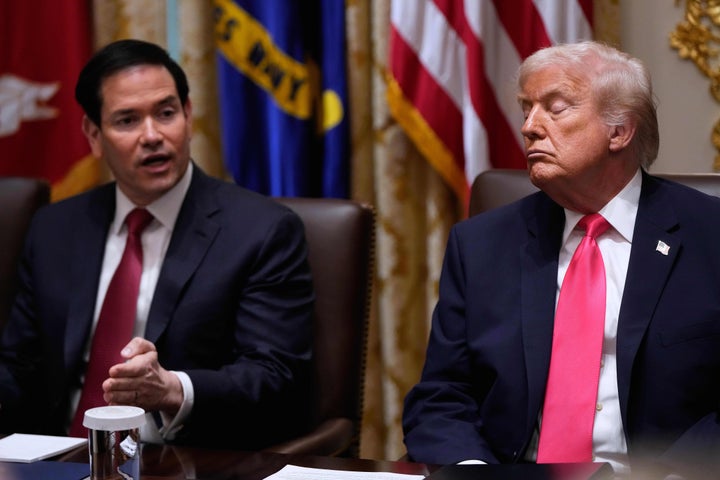
At a recent cabinet meeting, Marco Rubio was ass-kissing to Trump, saying something like, "the transformational foreign policy of this great man", and as he gestured toward Trump next to him, the old geezer was seeing absolutely conked out.
===============================================
Trump national security strategy calls for ‘cultivating resistance’ in Europe and changing US’ role in Western Hemisphere
Alejandra Jaramillo, CNN
Fri, December 5, 2025
The White House quietly (Why?) released President Donald Trump’s new national security strategy late Thursday, a 33-page document that elevates his “America First” doctrine and sets out the administration’s realignment of US foreign policy, from shifting military resources in the Western Hemisphere to taking an unprecedentedly confrontational posture toward Europe.
The strategy centers on Trump’s call for a “readjustment” of the US military presence in the Western Hemisphere to counter migration, drug trafficking and what it describes as the rise of adversarial powers in the region.
It outlines plans for a larger Coast Guard and Navy presence in the region and deployments to “secure the border and defeat cartels, including where necessary the use of lethal force.” The document frames this as part of a “Trump Corollary” to the Monroe Doctrine, an 1823 presidential call for European powers to respect the US’ sphere of influence in the west.
“The United States must be preeminent in the Western Hemisphere as a condition of our security and prosperity—a condition that allows us to assert ourselves confidently where and when we need to in the region,” the document says.
....
The strategy’s section on Europe represents a more dramatic escalation, warning that European nations face “economic decline” that could be “eclipsed by the real and more stark prospect of civilizational erasure.”
The document goes on to argue that “over the long term, it is more than plausible that within a few decades at the latest, certain NATO members will become majority non-European,” raising what it calls “an open question” about whether those countries would continue to view their alliance with the United States in the same way.
The administration’s strategy also asserts that the “Ukraine War has had the perverse effect of increasing Europe’s, especially Germany’s, external dependencies” and claims “a large European majority wants peace, yet that desire is not translated into policy, in large measure because of those governments’ subversion of democratic processes.”
The strategy blames European officials for blocking US-backed efforts to end the conflict and states that an end to “hostilities” is needed to stabilize European economies, prevent war, and reestablish stability with Russia: “It is a core interest of the United States to negotiate an expeditious cessation of hostilities in Ukraine, in order to stabilize European economies, prevent unintended escalation or expansion of the war, and reestablish strategic stability with Russia, as well as to enable the post-hostilities reconstruction of Ukraine to enable its survival as a viable state.”
A salient point in the Europe section of the strategy goes further, explicitly endorsing efforts to influence the domestic politics of US allies, saying the American broad policy toward Europe should prioritize “cultivating resistance to Europe’s current trajectory within European nations.” (LI: which is a call to all neo-Nazi, white supremacist violent groups to armed rebellion against their govenments, the objectie being to weaken Europe and force into submission to an American-Russian "Christian" alliance).
“Should present trends continue, the continent will be unrecognizable in 20 years or less. … We want Europe to remain European, to regain its civilizational self-confidence, and to abandon its failed focus on regulatory suffocation,” it says. [LI: Regulatory suffocation is code for deregulating environmental and economic policies and giving a free rein to giant corporations]
The chief spokesperson for the European Commission, Paula Pinho, said at a press briefing Friday that European leaders had not yet had “the time to look into (the document)” and were not in a “position to comment.”
The document also reiterates the administration’s push for “ending the perception, and preventing the reality, of NATO as a perpetually expanding alliance.”[LI: A nod to Vladimir Putin's rejection of Ukraine's joining NATO and the EU]
.....
The Trump administration’s strategy also outlines a dual-track approach to China, pushing to contain Beijing’s global influence while preserving economic ties and maintaining the current conditions on Taiwan, saying that “deterring a conflict over Taiwan, ideally by preserving military overmatch, is a priority.”
It also calls for “maintaining a genuinely mutually advantageous economic relationship” with China by prioritizing “reciprocity and fairness” and reducing US dependence on the country. According to the document, such a reset is key to sustaining US growth from “a $30 trillion economy in 2025 to $40 trillion in the 2030s.”
==============================================
On the same topic:
Trump reveals what he wants for the world
Nahal Toosi
Fri, December 5, 2025
AP
President Donald Trump intends for the U.S. to keep a bigger military presence in the Western Hemisphere going forward to battle migration, drugs and the rise of adversarial powers in the region, according to his new National Security Strategy.
The 33-page document is a rare formal explanation of Trump’s foreign policy worldview by his administration. Such strategies, which presidents typically release once each term, can help shape how parts of the U.S. government allocate budgets and set policy priorities.
The Trump National Security Strategy, which the White House quietly released Thursday, has some brutal words for Europe, suggesting it is in civilizational decline, and pays relatively little attention to the Middle East and Africa.
It has an unusually heavy focus on the Western Hemisphere that it casts as largely about protecting the U.S. homeland. It says “border security is the primary element of national security” and makes veiled references to China’s efforts to gain footholds in America’s backyard.
“The United States must be preeminent in the Western Hemisphere as a condition of our security and prosperity — a condition that allows us to assert ourselves confidently where and when we need to in the region,” the document states. “The terms of our alliances, and the terms upon which we provide any kind of aid, must be contingent on winding down adversarial outside influence — from control of military installations, ports, and key infrastructure to the purchase of strategic assets broadly defined.”
....
Trump’s paper, as well as a partner document known as the National Defense Strategy, have faced delays in part because of debates in the administration over elements related to China. Treasury Secretary Scott Bessent pushed for some softening of the language about Beijing, according to two people familiar with the matter who were granted anonymity to describe internal deliberations. Bessent is currently involved in sensitive U.S. trade talks with China, and Trump himself is wary of the delicate relations with Beijing.
The new National Security Strategy says the U.S. has to make challenging choices in the global realm. “After the end of the Cold War, American foreign policy elites convinced themselves that permanent American domination of the entire world was in the best interests of our country. Yet the affairs of other countries are our concern only if their activities directly threaten our interests,” the document states.
In an introductory note to the strategy, Trump called it a “roadmap to ensure that America remains the greatest and most successful nation in human history, and the home of freedom on earth.” [LI: Hahahahaaaaa].
But Trump is mercurial by nature, so it’s hard to predict how closely or how long he will stick to the ideas laid out in the new strategy. [LI: I =disagree with Politico: Trump is an idiot, this strategy paper is not of his making. He has a cabal of Radical Right criminals writing this stuff and using him as a prop to "quietly" disseminate this poison inside allied and friendly countries]. A surprising global event could redirect his thinking as well, as it has done for recent presidents from George W. Bush to Joe Biden.
Still, the document appears in line with many of the moves he’s taken in his second term, as well as the priorities of some of his aides. That includes deploying significantly more U.S. military prowess to the Western Hemisphere, taking numerous steps to reduce migration to America, pushing for a stronger industrial base in the U.S. and promoting “Western identity,” including in Europe.
The strategy even nods to so-called traditional values at times linked to the Christian right, saying the administration wants “the restoration and reinvigoration of American spiritual and cultural health” and “an America that cherishes its past glories and its heroes.” It mentions the need to have “growing numbers of strong, traditional families that raise healthy children.” [LI: Regression into religious barbarism, reinforcement of greedy raw capitalism, and a nostalgia of the past. That is exactly what the Nazis did].
.....
The strategy says the U.S. should enhance its relationships with governments in Latin America, including working with them to identify strategic resources — an apparent reference to [stealing their] materials such as rare earth minerals. It also declares that the U.S. will partner more with the private sector [Empowering more capitalistic cruelty and abuse of other countries' resources and environment] to promote “strategic acquisition and investment opportunities for American companies in the region.”
....
The administration promises to “rebalance America’s economic relationship with China, prioritizing reciprocity and fairness to restore American economic independence.”
But it also says “trade with China should be balanced and focused on non-sensitive factors” and even calls for “maintaining a genuinely mutually advantageous economic relationship with Beijing.”
The strategy says the U.S. wants to prevent war in the Indo-Pacific — a nod to growing tensions in the region, including between China and U.S. allies such as Japan and the Philippines.
“We will also maintain our longstanding declaratory policy on Taiwan, meaning that the United States does not support any unilateral change to the status quo in the Taiwan Strait,” it states. That may come as a relief to Asia watchers who worry Trump will back away from U.S. support for Taiwan as it faces ongoing threats from China. [LI: Trump will sell Taiwan to China if the latter concedes to substantial economic benefits to the US].
The document states that “it is a core interest of the United States to negotiate an expeditious [LI: Trump wants any deal on Ukraine as long as it is "quick" and regardless of long term conequences such as rewarding the acquisition of territories by force] cessation of hostilities in Ukraine,” and to mitigate the risk of Russian confrontation with other countries in Europe.
But overall it pulls punches when it comes to Russia — there’s very little criticism of Moscow.
Instead, it reserves some of its harshest remarks for U.S.-allied nations in Europe. In particular, the administration, in somewhat veiled terms, knocks European efforts to rein in far-right parties, calling such moves political censorship.
“The Trump administration finds itself at odds with European officials who hold unrealistic expectations for the [Ukraine] war perched in unstable minority governments, many of which trample on basic principles of democracy to suppress opposition,” the strategy states.
The strategy also appears to suggest that migration will fundamentally change European identity to a degree that could hurt U.S. alliances. “Over the long term, it is more than plausible that within a few decades at the latest, certain NATO members will become majority non-European,” it states. “As such, it is an open question whether they will view their place in the world, or their alliance with the United States, in the same way as those who signed the NATO charter.” “Our goal should be to help Europe correct its current trajectory,” it says.

.....
As Trump administration documents often do, the strategy devotes significant space to praising the commander-in-chief. It describes him as the “President of Peace” while favorably stating that he “uses unconventional diplomacy.”
.....
It also essentially dismisses the ambitions of many smaller countries. “The outsized influence of larger, richer, and stronger nations is a timeless truth of international relations,” the strategy states.


No comments:
Post a Comment