
[See follow-up piece by Cuban below]

Unlike private companies and corporations that often screw up or cheat for profit, government entities that provide services are nearly always impeccable: The IRS, Social Security Administration, Postal Service, Library of Congress, etc. always work with very few glitches. And if there are some, it is usually errors and mistakes but never profit that are behind it.
Mark Cuban is sooooooooooooo right in what he is suggetsing below.
=======================================================
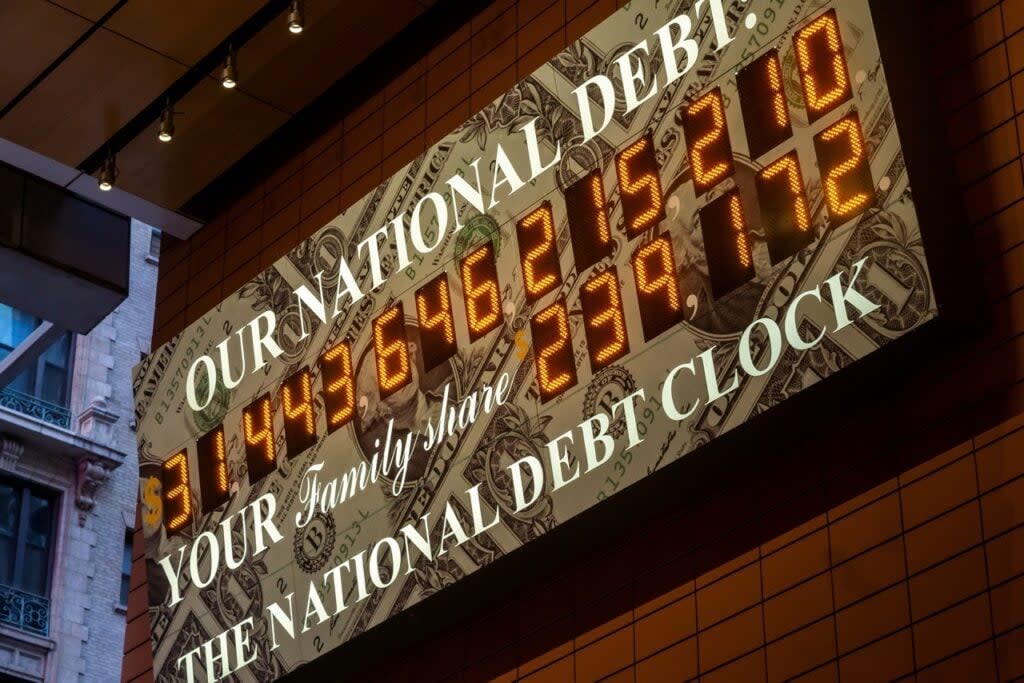
Mark Cuban Says We Could Pay Off The National Debt If Insurers Were Fined $100 Every Time They Over-Billed Or Denied Care
Adrian Volenik
Fri, January 2, 2026
Mark
Cuban is taking aim at the U.S. healthcare system, arguing that
widespread billing abuse by insurers and providers could be a major
source of federal revenue–if only they were held accountable.
“If
we fined insurers and providers $100 every time they over-billed,
incorrectly denied care or misrepresented any amount of patient out of
pocket, we could pay off the national debt,” the billionaire
entrepreneur posted on X last week.
Calls For System Overhaul
Cuban said the
system is rigged against everyday Americans who are forced to navigate a
confusing maze of billing, denials and surprise out-of-pocket costs.
“They play on the fear and information asymmetry that exists in
healthcare,” he wrote, calling for the breakup of major players in the
industry.
“Break them up. Make them divest non insurance
companies,” he said. “And when we are done with the insurance companies,
we go to the hospitals and then to the pharma wholesalers. Break em up.
Make the markets efficient again.”
Cuban’s post came in response
to a post from the Scalpel Policy Solutions founder Tanner Aliff, who
highlighted new state laws that give patients “deductible credit” for
paying cash prices that are lower than what insurance companies
typically reimburse. Aliff argued that these laws help patients save
money while still having their spending count toward their annual
deductible.
Aliff explained that instead of “blowing through your
entire deductible over a $6,000.00 MRI fee,” patients in certain states
can now pay about $300 in cash for the same service and still get
credit toward their deductible.
Per Aliff, only four states–Texas, Indiana, Tennessee and Oregon–have implemented some version of this reform.
Cuban
praised the effort and called for broader adoption. “If cash pay for
all [health care] could be counted against your deductible, we all could
shop and save money. If your state isn’t on this list, ask your
congressman why not,” he said.
Critics, however, questioned
whether the average patient can realistically pull this off. “That you
believe that consumers can actually execute this, in a coordinated
fashion, makes you delusional,” financial planner Jae Oh replied. “You
have clearly not spoken to real people with any illness. This messaging
is doing more harm than good.”
“It happens already. I email and
talk to people who buy from Cost Plus all the time,” Cuban replied,
referring to his online pharmacy. “I pay deductibles for people all the
time. I help people get their [prior authorizations] overturned. All the
time. The hardest part is having them count against their deductible.”
As
healthcare costs continue to climb, Cuban and others are betting that
empowering patients with clearer pricing and fewer restrictions could be
a step toward real accountability. Whether more states follow through
could be a key test for this growing reform movement.
© 2026 Benzinga.com. Benzinga does not provide investment advice. All rights reserved.
============================================
Mark Cuban Asks If You'd Support Universal Healthcare If It Only Cost $10 A Year — And Every Doctor Got Paid Twice As Much As They Do Now
Jeannine Mancini
Sat, January 3, 2026

Apparently, the real healthcare fantasy isn't free Band-Aids or shorter ER waits — it's paying doctors what they actually deserve.
Mark Cuban stirred things up last month by proposing a hypothetical so simple it left no room to hide behind politics. In a post on X, he asked: If, thanks to new tech and scale, the cost of caring for every person in the U.S. dropped to just $10 a year — and every doctor, nurse, and provider earned double what they make now, "would you be ok with taxpayers covering the cost of care for everyone?"
That's it. No disclaimers. Just one sharp question: If money and compensation were no longer the issue, would people finally support universal healthcare — or would they still find a reason not to?
Cuban's never been subtle about his frustration with the system. He's called it rigged, inefficient, and stacked with middlemen who get rich while doctors burn out and patients go broke. Through Cost Plus Drugs — his online pharmacy that sells medications at wholesale prices plus a 15% markup — he's been working to prove that prices can drop when the profit games stop.
But this post wasn't about drugs. It was about incentives. He wasn't just asking if people would support a $10-a-year system. He was making the case that doctors aren't the problem — they're underpaid, overworked, and deserve more. The real cost explosion, he implies, comes from somewhere else.
The responses? A mix of defensiveness, economic pushback, and quiet agreement.
One person replied, "Why couldn't each person just pay their own $10?" — implying that if care really cost that little, government wouldn't need to be involved at all. Others said doubling provider salaries would defeat the purpose. "Can you show me a single industry where doubling wages led to lower costs?" one asked.
Some saw it as a clever setup with no real-world application. "Mark got rich because he's a good salesman… this post shows."
But not everyone missed the point. "Outstanding question," one commenter wrote, adding that letting markets lower prices through transparency and scale could expand access and reward the professionals doing the work. That vision — low cost, high compensation, no middlemen — tracks closely with what Cuban's been trying to build in the pharmaceutical space.
He's said before there are two "healthcare hellholes": one where you're too broke to get help, and one where you're rich enough to pay out of pocket but still stuck in a broken system. In both, patients lose. So do doctors.
This wasn't a solution. It was a test. If the numbers made sense, if doctors finally got paid, and if care was affordable for everyone — would people say yes? Or would ideology still win?
That's the conversation Cuban wanted to spark. And judging by the reactions, it hit exactly where it was meant to.


No comments:
Post a Comment