
The Cornell gang rape scandal may not involve Donald Trump personally or directly. But it does open a window into the elitist white trash universe of Trump's own scandals involving women.
The Cornell gang rape scandal does not involve migrants or immigrants, legal or illegal. It is the sort of white upper class crime that often goes covered up and shielded from the law. The drug use in the Cornell case explains why and how Latin American cartels are so successful in smuggling and selling dangerous and illicit drugs in the US: Their "clients" are within the white American elitist circles of the likes of Donald Trump.
Yet Donald Trump makes a fanfare over low level drug dealers and smugglers, especially those from the migrant communities, who are easily targeted and do not have the protection of the elitist wealthy white ruling class in America.
Donald Trump never addresses the rampant drug use in his own white upper class universe of politicians, academics, high finance and such, as the Cornell case clearly shows. It is this drug use by the white trash upper class of the United States that fuels the drug smuggling from Latin America, but is never held to account because it is an untouchable ruling class.
This is not about Democrats and Republicans. This is about a two-tier system in which the same crime is treated differently depending on who commits it. If it is a lower class "brown" immigrant criminal, the entire US military is mobilized to hunt it on the streets, on the border and in the ocean. But if it is an upper class US-born "white" criminal, the ruling class protects it by an unspoken omerta rife with coverups that occasionally erupt into a scandal thanks to the dogged work of activists.
The more things change, the more they stay the same. Bob Dylan immortalized this racist two-tier system of justice in his song "The Lonesome Death of Hattie Carroll" about the 1963 murder of Hattie Carroll, a 51-year-old Black maid, by William Zantziger, a wealthy white tobacco farmer, in Maryland. While the Cornell case is not about white trash racism, it is about white trash sexism in which a woman victim takes the place of a black victim.
Every time we think that white racism and sexism have been defeated by decades of activism and awareness-raising, we discover that they are entrenched and endemic to the white American culture of violence and make a resurgence thanks to the likes of racists and sexists like Donald Trump who energize and normalize it.
And nothing exemplifies this white trash upper class better than the fraternity universe on American university campuses.
=================================================
Friday, Oct. 2, 2026

By Cereese Qusba
Sep 18, 2026 11:03 pm · Updated Sep 28, 2026 1:36 pm
A former Cornell student seeks damages from the University, several fraternity and sorority organizations and more after filing a lawsuit alleging that she was raped and coerced into consuming drugs at the Chi Phi fraternity house at Cornell in 2024.
Editor’s Note: The content of this article contains detailed descriptions of sexual assault and drugging.
A former Cornell student filed a lawsuit on Monday, alleging that she was gang raped after being coerced into consuming drugs by several men at the Chi Phi fraternity house at Cornell in 2024.
She is suing Cornell University, several Chi Phi fraternity organizations, seven current and former students, several sorority organizations, the former president of Cornell’s Chi Phi chapter, a local bar and several unnamed individuals.
“What happened to me was horrific and deeply disturbing,” the plaintiff told The Sun. “Almost two years later, I still carry the weight of its impact every day and night.”
The plaintiff, identifying as Jane Doe, filed this lawsuit after an initial report was made to the Cornell community on Nov. 8, 2024.
The Chi Phi members named in the lawsuit are defendants Matthew Ingalls, Johnathan Newell, Winston Lee, Gillio Lopes, Diego Sarabia, Scott Norris and Scott Kretzschmar.
The Alleged Incident
On Oct. 19, 2024, the night of the alleged drugging and sexual assault, the plaintiff claims that her evening began at Cornell’s Tri-Delta house. Here, she consumed hard liquor before attending a Tri-Delta National’s Alpha Beta Chapter event hosted at Moonies Bar & Nightclub.
At Moonies, the plaintiff claimed she was marked on her hands as underage and was clearly intoxicated. Despite this, the plaintiff was served alcoholic beverages by Moonies employees.
At approximately 11 p.m., the plaintiff allegedly left Moonies and stopped at the Lot 10 bar, then “stumbled alone” to Chi Phi National’s Xi chapter’s fraternity house, located at 107 Edgemoor Ln., to meet her friend, defendant Ingalls.
At the Chi Phi house, defendant Ingalls allegedly proposed having a threesome with him and another fraternity brother. The plaintiff was “incapable of consenting,” according to the lawsuit. Ingalls still allegedly brought the plaintiff to a room.
The plaintiff claims that defendants Ingalls and Newell pressured her to snort a white, powdery substance claimed to be ketamine and supplied her with marijuana and a liquor believed to be high-proof rum.
Without the plaintiff’s consent, defendant Ingalls initiated oral sex while defendant Newell engaged in vaginal intercourse, according to the lawsuit. Throughout the alleged assault, defendant Newell slapped the plaintiff on the buttocks multiple times, which the plaintiff claims resulted in bruising she noticed the next day.
Defendant Lopes joined the alleged assault, and began kissing the plaintiff while Newell groped her from behind, according to the lawsuit. The two then placed her on a bed and again initiated sex with the plaintiff without her consent.
At approximately 1:42 a.m., defendant Newell allegedly encouraged fraternity brothers to join him, sending a message about “free pussy” upstairs to a Snapchat group entitled “Chi Phi Actives,” which the lawsuit describes as a group chat for Xi chapter members.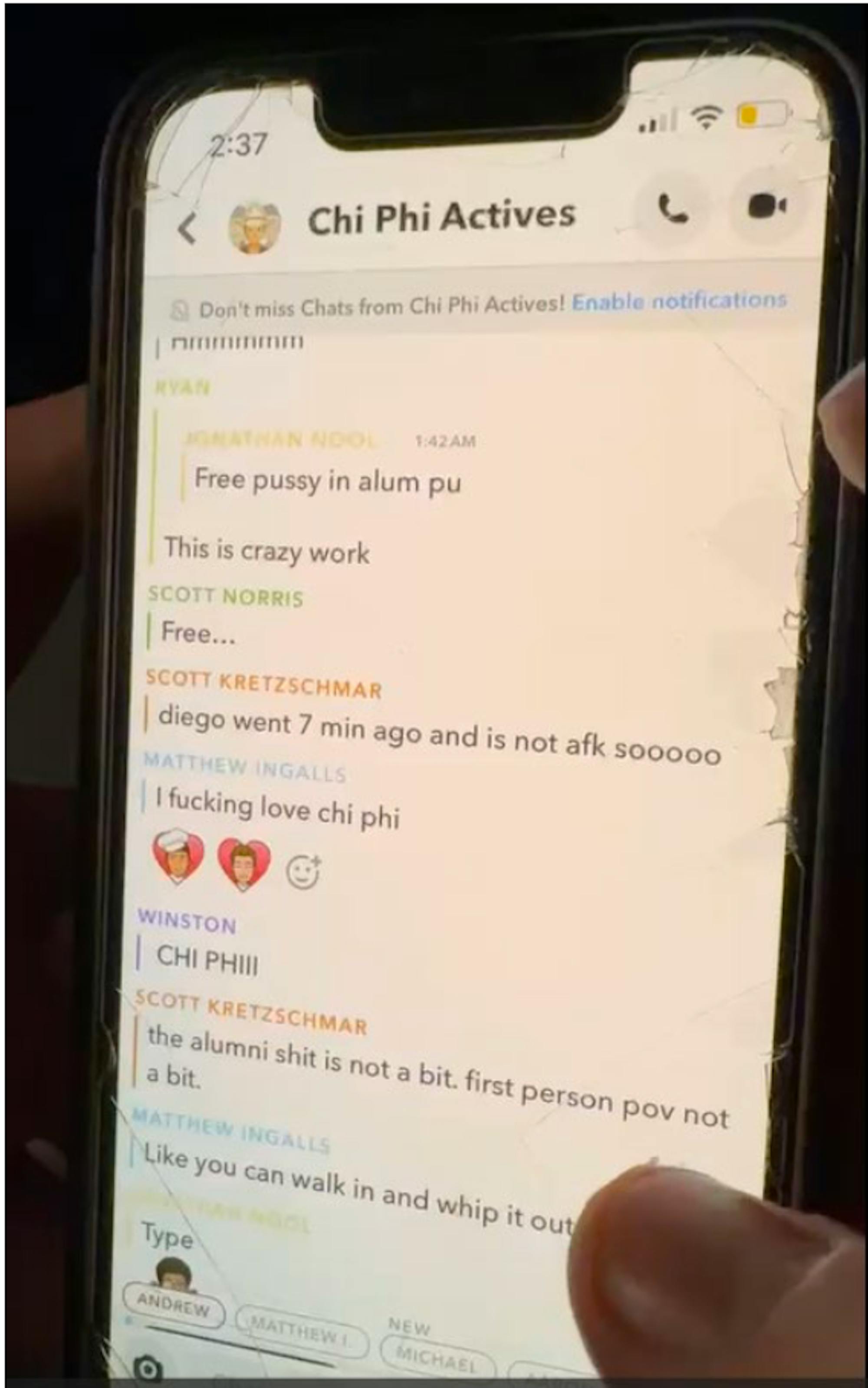
A Snapchat groupchat titled "Chi Phi Actives," in which a defendant allegedly sent a message saying, "free pussy" upstairs. (Photo taken from the lawsuit)
Multiple other members of the Xi chapter, including defendant Sarabia, entered the room with the plaintiff while she attempted to hide her naked body under the covers of the bed.
The plaintiff claimed she pushed defendant Sarabia away as he grabbed her face and kissed her.
The lawsuit states that the plaintiff’s phone was on the other side of the room and she “felt as if there was no way for her to escape this room full of predatory, fraternity men.”
Defendant Newell then “commanded” the plaintiff to snort a line of ketamine off of his erect penis, according to the suit.
While she was lying on her back, defendants Ingalls, Newell, Lee, Lopes, Sarabia, Norris and Kretzschmar poured and snorted lines of ketamine over her body.
Defendants Ingalls and Lee took the plaintiff into another room, which was believed by the defendant to be the office of Orazio Petito, president of Chi Phi at Cornell at the time. Defendants Ingalls and Lee forced oral and vaginal sex upon her simultaneously and made her snort more ketamine. The assault lasted until around 5:45 a.m., according to the lawsuit.
The filing states that the plaintiff was completely incapacitated at this point and came into consciousness later that day on Oct. 20, 2024.
The lawsuit states that the plaintiff was in a “very vulnerable situation” when she was allegedly sexually assaulted by defendants Ingalls, Newell, Lee, Lopes, Sarabia, Norris and Kretzschmar. The lawsuit claims that the student defendants were “fully aware” of her condition.
Jeremy Saland, an attorney for defendant Kretzschmar, disputed the allegations against his client in a statement sent after publication, saying the defense possesses evidence that contradicts the plaintiff’s account.
“We wholeheartedly deny the allegations in the complaint against Scott Kretzschmar,” Saland wrote to The Sun. “It is disappointing the claims against him were even made considering we possess documents that thoroughly corroborate our position, including her own words, statements from other parties, and scientific evidence demonstrating they are false.”
The student defendants could not immediately be reached for comment.
The plaintiff reported the incident to the Cornell University Police Department on Nov. 8, 2024, and that same day, the Xi chapter was placed on temporary suspension for alleged violations of the Student Code of Conduct. Temporary suspensions were also issued for defendants Ingalls, Newell, Lee, Lopes, Sarabia, Norris and Kretzschmar, according to the lawsuit.
The defendants were offered the opportunity to mitigate their conduct by submitting essays to the University, according to the lawsuit.
On Nov. 26, 2024, the University released a statement, titled “Update on disturbing allegations of sexual violence,” explaining that the University was continuing to investigate the incident.
In January 2025, the University began a Title IX investigation in response to the plaintiff’s Formal Complaint, according to the lawsuit.
According to the complaint, Cornell’s Title IX investigation is believed to have concluded, while the Ithaca Police Department is still investigating the incident.
The Complaint
The complaint brings claims against the University for negligence, negligent supervision, breach of contract, violations of state human rights and education laws and negligent infliction of emotional distress.
It also accuses Tri-Delta entities of negligence and breach of contract, Chi Phi defendants of negligent supervision and seven student defendants of sexual assault, sexual battery and intentional infliction of emotional distress.
A representative from the Tri-Delta Executive Office did not respond to a request for comment.
The plaintiff brings claims against Moonies Bar & Nightclub, alleging that the bar and its employees violated New York’s Dram Shop Act — which can hold alcohol vendors liable in certain circumstances when they knowingly serve persons who are underage.
Moonies denied the allegations of negligence and violations of New York’s Dram Shop Act.
In a statement sent to The Sun after publication, a Moonies representative wrote that on Oct. 19, 2024, Moonies had a contract in place with Tri-Delta as it hosted the sorority’s private event. Per the contract, Moonies marked the hands of underage guests, provided wristbands to those over 21 years old and “no alcohol was served to guests who had mark[s] on their hands,” according to the representative.
“Our bartenders strongly followed the rules and only served guests who had wristbands on their hands,” the representative wrote.
The Moonies representative reiterated that the plaintiff’s claim that she was served alcohol at Moonies was “completely inaccurate.”
The lawsuit seeks damages from all defendants. The lawsuit “specifically seeks” damages from Cornell, fraternity and sorority organizations, certain faculty, alumni and executive board members and Petito, which the lawsuit described as failing to properly supervise or monitor the seven current and former student defendants.
When asked by The Sun about the pending litigation, a University spokesperson declined to comment. Petito did not respond to a request for comment by publication.
“In the aftermath, I was deeply disappointed by the lack of support I received from the student community,” the plaintiff told The Sun. “What I experienced was already devastating, but that pain was compounded by being criticized and ostracized at a time when I needed compassion, support and care the most.”
Editor’s note: Cereese Qusba is a member of Tri-Delta at Cornell.
Update, Sept. 19, 11:35 a.m.: This article has been updated to include a statement from defendant Scott Kretzschmar’s attorney, and to reflect that The Sun reached out to Tri-Delta, Moonies Bar & Nightclub and the student defendants, and they did not immediately respond to a request for comment.
Update, Sept. 22, 4:45 p.m.: This article has been updated to include a statement from Moonies Bar & Nightclub.
Cereese Qusba
Cereese Qusba is a member of the Class of 2027 in the College of Arts and Sciences. She was a news editor for the 143rd Editorial Board and is a senior editor for the 144th Editorial Board. She can be reached at cqusba@cornellsun.com.


No comments:
Post a Comment