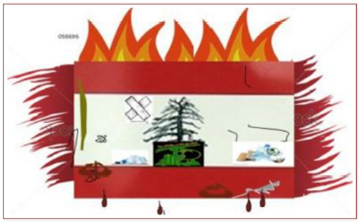
Fundamentalist Shiite octopus's tentacles reach Baku in Azerbaijan.
No, the Lebanese will tell you, especially the followers of Syria and the Free Patriotic Movement of Michel Aoun, Hezbollah is JUST a purely Lebanese organization whose goal is ONLY to liberate the south from the very bad - but largely non-existent - Israeli occupation of some abandoned rocky ravines called the Shebaa Farms.
But here is Hezbollah, after wiping out and murdering every American, Canadian, European and other friendly Christian clergyman, teacher, university administrator, and UN worker from Lebanon in the 1980s; blowing up every peacekeeping force that Lebanon needed badly in the 1980s; blowing up every embassy or consulate in Beirut; hijacking planes to Beirut; bombing a Jewish center in Buenos Aires in 1994; and recently trying to destabilize Egypt; now it was caught trying to bomb the Israeli embassy in Baku, Azerbaijan.
Hezbollah's goals are not Lebanese. It is masquerading as a Lebanese welfare society, paying poor Lebanese Shiite villagers from Iranian money to muster their allegiance, make them wear burqas and beards, and herd them like sheep at massive rallies, supposedly to show its power..... and then acting at the behest of Iran to further destabilize Lebanon after 40 years of agony and suffering. As if the Lebanese haven't had enough "liberation" and "resistance", alone against Israel, when all the other fucking Arabs have made peace with Israel.
Is this what the Lebanese voter is going to vote for? The voters next Sunday who plan to vote for Hezbollah or its allies should ask themselves the question:
- Is this the Lebanon I want? A country of criminals, outlaws, terrorists?
- A country with the reputation of Jouret al-Khara - the cesspool?
- A country whose image abroad is that of bearded mullahs running the show with Kalashnikovs and martyrs and blood and more primitiveness and backwardness?
- A country at which all the cowards of Sunni Arab countries threw the Palestinian problem to deal with while they all washed their hands from it?
- The only fucking Arab country fighting Israel?
Is this what the Lebanese people? To be the useful brave idiots of the Arab world?
All the Arab countries are building and developing and advancing. They are joining the rest of the world with economic power and entrepreneurship. They are gradually leaving behind the defunct nostalgias and backwardness of the past...All of them, except Lebanon, which is gradually sinking backwards, its environment destroyed, its economy in shambles, its population brutalized and impoverished by decades of the same old resistance and Arab nationalism bullshit.
Kuwait has a quota for women in parliament and state instutions. Lebanon does not.
Every other Arab country is building a formidable airline, whereas Lebanon, whose Middle East Airline used to be the sole international airline in the region is now a nothing in the industry....
Arab countries are taking serious measures to protect their environments and invest in the future for the post-oil era... What is Lebanon doing? It is begging for 2 used Migs from Russia to "fight Israel".
If Lebanon is not the saddest, stupidest, self-inflicted tragedy yet of the 21st century, then I don;t know what is.
VOTE FOR THE FUTURE - DO NOT VOTE FOR THE PAST.
VOTE FOR NEW NAMES AND NEW FACES - AREN'T YOU TIRED OF THE SAME FAMILIES KILLING YOUR CHILDREN AND ROBBING YOU OF EVERY OPPORTUNITY FOR A BETTER LIFE?
VOTE YOUR FUTURE....
Hanibaal
Sunday, May 31, 2009
Saturday, May 30, 2009
Lebanon: Primitive Tobacco Dumping Ground of the World
The Lebanese claim to be fighting American imperialism and hegemony... But in their daily lives they behave like idiots, they are the guinea pigs for big american companies that sell the Lebanese everything that America does not want, like tobacco. The Lebanese take everything that is bad from America, but they don't take what is good from America, like separation of church and state, like real democracy, like real freedom. Smoking is one example. The Lebanese pay billions a year on smoking and they know that smoking causes them diseases. The money they pay for American cigarettes is money that ends up with American tobacco companies who them pay it in taxes to Uncle Sam, who in turn gives it to ISrael at the rate of 5 billion dollars a year, and then Israel bombs Lebanon to the ground.
By smoking, the Lebanese are funding Israel.
And of course, the Lebanese government makes its own money from cigarettes and tobacco....This is the Lebanese government that does not know how to distribute electricity to 3 million people. Compare that to a city like Mexico City or New York City that have 15 million people, and they have shortages of electricity once every 10 years. In Lebanon, it is once every 10 minutes.
This is the so-called "modern" Lebanon that the Lebanese brag about. This is the Lebanon in which garbage is everywhere, around every corner, every bend in the road, down the valleys on mountain roads, and behind every house.
The country stinks from diesel fumes, is rife with corruption, and is dominated by bearded religious people.
My advice to tourists: DO NOT GO TO LEBANON. YOU"LL CATCH CANCER FROM ALL THE SMOKING in your face, from all the pollution from diesel busses and trucks and from all the garbage. There is no electricity, no fast Internet, no reliable phones, cell phone rates are the highest in the world....Lebanon is a real dump.
Hanibaal
-----------------------------------------------------------------
Health professionals say number of smokers in Lebanon among highest in Middle East.
By Jocelyne Zablit - BEIRUT
Want to indulge in a guilt-free tobacco experience? Then head to Lebanon, a smoker's paradise where you can work, dine and have your hair styled in a cloud of smoke. The anti-smoking lobby is barely a blip on the radar and the government cares little about the issue.
So the price of Cuban Havanas is among the world's cheapest, cigarettes are free of punitive pricing and health warnings are barely visible on the side of packs -- far from the bold warnings and pictures the World Health Organisation (WHO) is promoting on "World No Tobacco Day" on Sunday.
Even teenagers can afford the average one dollar per pack, compared to an average seven dollars (five euros) in France or nearly nine dollars in Britain.
"The minute you land in this country you start huffing and puffing," said Ghazi Zaatari, a physician and chairman of the department of pathology at the American University of Beirut as well as head of a WHO study group on tobacco regulation.
"As far as tobacco is concerned, Lebanon is a health disaster."
George Saade, a cardiologist and head of the tobacco control unit at the ministry of health, presents a similar picture. "The Lebanese government is doing nothing as far as tobacco control is concerned," he lamented, partly attributing lax enforcement to a rocky political situation.
He said his unit, located in two small offices at the ministry, barely has a 20,000-dollar annual budget, a drop in the bucket compared to the millions available to the tobacco industry.
"Tobacco companies are very powerful in this country and they are involved in many things that would raise concerns of conflict of interest elsewhere," Saade said.
"They sponsor concerts, television shows and sports events where free cigarettes are sometimes distributed.
"You even see them at ski resorts," he added. "Where there are youths, there are tobacco companies."
The area manager for Philip Morris, the largest importer of cigarettes in Lebanon, rejected the accusations. "We market our products to adult smokers only and we're very strict about that," said Emile Moukarzel.
"We try our best to prevent minors from smoking, not only because it is mandated by the serious health effects of our product but also because it also makes business sense."
British American Tobacco, the second largest importer of cigarettes in Lebanon, had no one available to comment for this article.
Health professionals say the number of smokers in Lebanon is among the highest in the region and cancer-related illnesses directly linked to tobacco are rising at a rapid rate.
An estimated 3,500 people die annually from illnesses related to smoking, they said.
"In the last five years we have seen a 17-percent increase in cardio-vascular disease while the United States saw a 17-percent drop for the same period," Saade said.
Ironically, some of the local companies that market cigarettes are also the agents for cancer-fighting drugs.
Most worrisome is a growing trend of narghile, or water pipe, smokers, especially among teenagers who wrongly believe it is less harmful to their health than cigarettes, experts say.
"We are facing every day new evidence about narghile smoking, which is spreading among all age groups but more specifically among youths," said Rima Nakkash, an American University of Beirut professor who is doing research on the issue.
She said according to a 2005 survey carried out by WHO, 60 percent of youths in Lebanon aged between 13 and 15 smoke cigarettes, narghile or cigars, the highest number in the region.
Overall, an estimated 42 percent of males and 30 percent of females smoke in Lebanon, a country of 4.5 million inhabitants, health experts say.
"The tobacco industry has recognized the Middle East as one region of the world which has the least restrictive regulations compared to other countries, even in Asia," Zaatari said.
"So sometimes they use countries like Lebanon as dumping grounds for products they are unable to bring into other countries.
"And they are particularly interested in young people because once you're hooked, you're hooked for life," he added.
Zaatari also noted that although Lebanon signed WHO's Framework Convention on Tobacco Control in 2005 it has failed to ratify the document and has shown little interest in enforcement.
For example a survey conducted at 40 restaurants nationwide in coordination with the Harvard School of Public Health showed that air quality in such establishments was, on average, hazardous by WHO standards.
"The thing with Lebanon is we are behind 20 or 30 years as far as tobacco control but we can learn from the experience of other countries," Nakkash said. "We can learn how they failed and succeeded.
"It's not like we are drawing up a nuclear strategy."
By smoking, the Lebanese are funding Israel.
And of course, the Lebanese government makes its own money from cigarettes and tobacco....This is the Lebanese government that does not know how to distribute electricity to 3 million people. Compare that to a city like Mexico City or New York City that have 15 million people, and they have shortages of electricity once every 10 years. In Lebanon, it is once every 10 minutes.
This is the so-called "modern" Lebanon that the Lebanese brag about. This is the Lebanon in which garbage is everywhere, around every corner, every bend in the road, down the valleys on mountain roads, and behind every house.
The country stinks from diesel fumes, is rife with corruption, and is dominated by bearded religious people.
My advice to tourists: DO NOT GO TO LEBANON. YOU"LL CATCH CANCER FROM ALL THE SMOKING in your face, from all the pollution from diesel busses and trucks and from all the garbage. There is no electricity, no fast Internet, no reliable phones, cell phone rates are the highest in the world....Lebanon is a real dump.
Hanibaal
-----------------------------------------------------------------
Health professionals say number of smokers in Lebanon among highest in Middle East.
By Jocelyne Zablit - BEIRUT
Want to indulge in a guilt-free tobacco experience? Then head to Lebanon, a smoker's paradise where you can work, dine and have your hair styled in a cloud of smoke. The anti-smoking lobby is barely a blip on the radar and the government cares little about the issue.
So the price of Cuban Havanas is among the world's cheapest, cigarettes are free of punitive pricing and health warnings are barely visible on the side of packs -- far from the bold warnings and pictures the World Health Organisation (WHO) is promoting on "World No Tobacco Day" on Sunday.
Even teenagers can afford the average one dollar per pack, compared to an average seven dollars (five euros) in France or nearly nine dollars in Britain.
"The minute you land in this country you start huffing and puffing," said Ghazi Zaatari, a physician and chairman of the department of pathology at the American University of Beirut as well as head of a WHO study group on tobacco regulation.
"As far as tobacco is concerned, Lebanon is a health disaster."
George Saade, a cardiologist and head of the tobacco control unit at the ministry of health, presents a similar picture. "The Lebanese government is doing nothing as far as tobacco control is concerned," he lamented, partly attributing lax enforcement to a rocky political situation.
He said his unit, located in two small offices at the ministry, barely has a 20,000-dollar annual budget, a drop in the bucket compared to the millions available to the tobacco industry.
"Tobacco companies are very powerful in this country and they are involved in many things that would raise concerns of conflict of interest elsewhere," Saade said.
"They sponsor concerts, television shows and sports events where free cigarettes are sometimes distributed.
"You even see them at ski resorts," he added. "Where there are youths, there are tobacco companies."
The area manager for Philip Morris, the largest importer of cigarettes in Lebanon, rejected the accusations. "We market our products to adult smokers only and we're very strict about that," said Emile Moukarzel.
"We try our best to prevent minors from smoking, not only because it is mandated by the serious health effects of our product but also because it also makes business sense."
British American Tobacco, the second largest importer of cigarettes in Lebanon, had no one available to comment for this article.
Health professionals say the number of smokers in Lebanon is among the highest in the region and cancer-related illnesses directly linked to tobacco are rising at a rapid rate.
An estimated 3,500 people die annually from illnesses related to smoking, they said.
"In the last five years we have seen a 17-percent increase in cardio-vascular disease while the United States saw a 17-percent drop for the same period," Saade said.
Ironically, some of the local companies that market cigarettes are also the agents for cancer-fighting drugs.
Most worrisome is a growing trend of narghile, or water pipe, smokers, especially among teenagers who wrongly believe it is less harmful to their health than cigarettes, experts say.
"We are facing every day new evidence about narghile smoking, which is spreading among all age groups but more specifically among youths," said Rima Nakkash, an American University of Beirut professor who is doing research on the issue.
She said according to a 2005 survey carried out by WHO, 60 percent of youths in Lebanon aged between 13 and 15 smoke cigarettes, narghile or cigars, the highest number in the region.
Overall, an estimated 42 percent of males and 30 percent of females smoke in Lebanon, a country of 4.5 million inhabitants, health experts say.
"The tobacco industry has recognized the Middle East as one region of the world which has the least restrictive regulations compared to other countries, even in Asia," Zaatari said.
"So sometimes they use countries like Lebanon as dumping grounds for products they are unable to bring into other countries.
"And they are particularly interested in young people because once you're hooked, you're hooked for life," he added.
Zaatari also noted that although Lebanon signed WHO's Framework Convention on Tobacco Control in 2005 it has failed to ratify the document and has shown little interest in enforcement.
For example a survey conducted at 40 restaurants nationwide in coordination with the Harvard School of Public Health showed that air quality in such establishments was, on average, hazardous by WHO standards.
"The thing with Lebanon is we are behind 20 or 30 years as far as tobacco control but we can learn from the experience of other countries," Nakkash said. "We can learn how they failed and succeeded.
"It's not like we are drawing up a nuclear strategy."
Friday, May 29, 2009
Hariri: Prototype of Hopeless Arab Nationalism
1. Saad Hariri's father was killed by a bomb in 2005 - Syria and/or Hezbollah are the main culprits.
2. Saad Hariri's political allies, friends and aides in Lebanon were hunted down and murdered by car bombs and assassinations during 2 years, again with Syria and/or Hezbollah's hands behind the wave of attacks.
3. Saad Hariri is running on a platform that Lebanon is first, Lebanon's causes come before other causes, stability, peace, independence and sovereignty come before everything else.
4. Saad Hariri, as the political infant he is, has been bottle-fed by Saudi Arabia and the United States. Without them, he would be a nothing. He is allied with the anti-Syrian, anti-Iranian, and anti-Hezbollah forces in the international community.
Yet:
5. At the first opportunity that this idiot has to speak, he blurts out the same old and putrid slogans of pan-Arab nationalism, in which people who killed his father and ruined his country (Syria, Iran and Hezbollah) are his "brothers", and his neighbor who is fighting his enemy for him becomes his "enemy".
I know it is difficult to understand the mind of a fucking Sunni Arab and how it works. It just is completely upside down on logic. And as long as the SUnnis of Lebanon continue to think this way, Lebanon will not know peace. In the 1960s, 1970s and 1980s, the Lebanese Sunnis favored Arab nationalism and Palestinian nationalism over Lebanon, and they destroyed Lebanon in the process. Then they said they learned their lessons. But now that they should see Syria and Hezbollah as their real enemy, and Israel as just a neighbor with which to make peace and get on with life (like Egypt, like Jordan, and like the Palestinians themselves...), they instead continue to kiss the hand that is killing them and make an enemy of those withe whom they should be friends.
Just notice the contradicting statements below (in bold) made by Hariri recently.
Hanibaal
--------------------------------------------------------
From Xinhua news agency:
Lebanese Sunni majority leader Saad Hariri said Wednesday that he is against Israel because it is the enemy, Future TV reported Thursday.
"We are neither against Iran nor against Syria, we are only against Israel because it is our enemy," Hariri told a gathering in West Bekaa during his election campaign.
He stressed that his pro-government coalition of March 14 forces wants Lebanon to have good relations with all countries.
He also said coexistence among Lebanese remains to be the basis of building a state, highlighting the importance of maintaining calm in the country.
Hariri said that his coalition's conflict with Hezbollah-led opposition was based on political disagreement over key issues, such as security and economy, as well as the decision of war and peace.
Hariri's coalition blamed Hezbollah for the 2006 July war with Israel, while they believe that Hezbollah did not consult the Lebanese government before kidnapping the two Israeli soldiers that provoked a 34-day devastating war.
Sunni leader Hariri, has been leading the political campaign against Syria, which he accused of being behind his father's assassination in 2005. He also accused Lebanese Shiite armed group Hezbollah of carrying out the Iranian instruction in Lebanon.
2. Saad Hariri's political allies, friends and aides in Lebanon were hunted down and murdered by car bombs and assassinations during 2 years, again with Syria and/or Hezbollah's hands behind the wave of attacks.
3. Saad Hariri is running on a platform that Lebanon is first, Lebanon's causes come before other causes, stability, peace, independence and sovereignty come before everything else.
4. Saad Hariri, as the political infant he is, has been bottle-fed by Saudi Arabia and the United States. Without them, he would be a nothing. He is allied with the anti-Syrian, anti-Iranian, and anti-Hezbollah forces in the international community.
Yet:
5. At the first opportunity that this idiot has to speak, he blurts out the same old and putrid slogans of pan-Arab nationalism, in which people who killed his father and ruined his country (Syria, Iran and Hezbollah) are his "brothers", and his neighbor who is fighting his enemy for him becomes his "enemy".
I know it is difficult to understand the mind of a fucking Sunni Arab and how it works. It just is completely upside down on logic. And as long as the SUnnis of Lebanon continue to think this way, Lebanon will not know peace. In the 1960s, 1970s and 1980s, the Lebanese Sunnis favored Arab nationalism and Palestinian nationalism over Lebanon, and they destroyed Lebanon in the process. Then they said they learned their lessons. But now that they should see Syria and Hezbollah as their real enemy, and Israel as just a neighbor with which to make peace and get on with life (like Egypt, like Jordan, and like the Palestinians themselves...), they instead continue to kiss the hand that is killing them and make an enemy of those withe whom they should be friends.
Just notice the contradicting statements below (in bold) made by Hariri recently.
Hanibaal
--------------------------------------------------------
From Xinhua news agency:
Lebanese Sunni majority leader Saad Hariri said Wednesday that he is against Israel because it is the enemy, Future TV reported Thursday.
"We are neither against Iran nor against Syria, we are only against Israel because it is our enemy," Hariri told a gathering in West Bekaa during his election campaign.
He stressed that his pro-government coalition of March 14 forces wants Lebanon to have good relations with all countries.
He also said coexistence among Lebanese remains to be the basis of building a state, highlighting the importance of maintaining calm in the country.
Hariri said that his coalition's conflict with Hezbollah-led opposition was based on political disagreement over key issues, such as security and economy, as well as the decision of war and peace.
Hariri's coalition blamed Hezbollah for the 2006 July war with Israel, while they believe that Hezbollah did not consult the Lebanese government before kidnapping the two Israeli soldiers that provoked a 34-day devastating war.
Sunni leader Hariri, has been leading the political campaign against Syria, which he accused of being behind his father's assassination in 2005. He also accused Lebanese Shiite armed group Hezbollah of carrying out the Iranian instruction in Lebanon.
Tuesday, May 26, 2009
War Again in Middle East & Lebanon Again its Front
Kill me once, kill me twice: Will Lebanon finally Expire?
The formula hasn't changed since the mid 1960s. Mighty actors fighting it out in the Middle East, and Lebanon is the boxing ring where they settle their scores.
This time, the players are lining up in this manner:
- Nuclear Iran, on the verge of elections that pose a challenge to Ahamdinejad's hardline approach.
- A proxy Hezbollah in Lebanon ready to execute Tehran's orders, no matter how destructive they might be to Lebanon. Lebanon's parliamentary elections this June 7 appear to be headed for a victory by Hezbollah, thus replicating in Lebanon the Hamas-in-Gaza syndrome.
- A weak-pacifist Obama administration, which for all its good intentions and goodwill, does not look like it has either the recipe or the mettle to force a solution. Obama can tough-talk the Israelis as much as he wants, but the powerful Jewish lobby will make him pay a dear price if he crosses the lines set for US policy on Israel.
- A relatively weak new government in Israel in which Netanyahu is trying to show that he can do more or better than his predecessor. Using the Iranian nuclear threat as a pretext, Netanyahu will go forward with an attack against Tehran, which would derail whatever is left of a peace process, thus giving Israel the lebensraum to build more settlements and steal more land from their "partners", the moderate Palestinians. Netanyahu may not wait for the Iranian elections: The Ahmadinejad pretext may not be available if the moderates win in Iran.
So the question I ask myself these days:
If Israel attacks Iran's nuclear sites some time this summer, like it did with Iraq's Ozirak back in 1981, what is the likely result?
- Iran's long range missiles are basically useless because of the distance, much like Saddam's missiles of 1991. The only chance that they may have a serious impact is that if they carry nuclear heads, which, according to all estimates, Iran is still far from having.
- Any retaliation that Iran might think about is really a Hezbollah barrage onto Israel from southern Lebanon, where Hezbollah has sotckpiled - both before and after UN resolution 1701 in 2006 - an arsenal of upwards of 30,000 missiles.
- Both the Israelis and the Hezbollah terrorists have learned much from their 2006 war: Hezbollah knows that the only price it will have to pay is a revolt by the Lebanese people who really care less for the ideological underpinnings of Hezbollah's hatred of Israel than to pay like idiots, yet again, the price of the wars of outsiders. As Israel has said many times in the recent past, with Hezbollah in the Lebanese government (even now in the current government, and definitely if it wins the elections), then Israel's target this time will be the Lebanese State, its institutions, government facilities, its army, etc... Thus a more savage retaliation by Israel than in 2006 is likely to force a deeper wedge between the Lebanese people and Hezbollah.
- But Hezbollah is at the end of its rope. It has alienated the Lebanese in 2006, who still went along with the argument of an Israeli overreaction, or the liberation of fucking Shebaa, or all the other unjustifiable justifications. It then alienated them even more in May 2008 when its goons overran the streets and killed people right and left just because the government ordered it to shut down its own spy communications system. There is so much that a people like the Lebanese, who have been brutalized for 40 years because of fucking Palestine and Arabism and all the other ideologies they care very little about, can take. We are quickly approaching the breakpoint between the two camps in Lebanon.
- Thus, a brief, but very intense war between Hezbollah and Israel is likely to degenerate into a Lebanese civil war, much like the schism between Hamas and the Palestinian Authority in Palestine. In Lebanon, there will be two governments, one Shiite-led, one Sunni-led, each with its own Christian allies (as the Christian camp is already divided between the two). Hezbollah might exercise authority over the south and east of the country, up to the southern suburbs of Beirut, while the Sunni camp will rule north of Beirut. Like in 1975-1976, when Lebanon descended into anarchy during the equally pacifist Carter administration, this time around, Obama is likely to remain engaged in futile diplomacy while the killing goes on.
The fact is that Hezbollah in Lebanon will never disarm by itself , and as long as it is supported by Iran and Syria, it will only be disarmed by force. And the Lebanese people will pay the price with a protracted war, like they did when the PLO was disarmed in 1982 (in Beirut) by an Israeli invasion and after close to two decades of fighting Israel from Lebanon. The parallels between the PLO episode and the Hezbollah episode are uncanny: Their conclusions are likely to be very similar.
So my fellow Lebanese: Brace yourselves. Stockpile canned food, candles, gasoline, and generators. Here we go again.
Hanibaal
The formula hasn't changed since the mid 1960s. Mighty actors fighting it out in the Middle East, and Lebanon is the boxing ring where they settle their scores.
This time, the players are lining up in this manner:
- Nuclear Iran, on the verge of elections that pose a challenge to Ahamdinejad's hardline approach.
- A proxy Hezbollah in Lebanon ready to execute Tehran's orders, no matter how destructive they might be to Lebanon. Lebanon's parliamentary elections this June 7 appear to be headed for a victory by Hezbollah, thus replicating in Lebanon the Hamas-in-Gaza syndrome.
- A weak-pacifist Obama administration, which for all its good intentions and goodwill, does not look like it has either the recipe or the mettle to force a solution. Obama can tough-talk the Israelis as much as he wants, but the powerful Jewish lobby will make him pay a dear price if he crosses the lines set for US policy on Israel.
- A relatively weak new government in Israel in which Netanyahu is trying to show that he can do more or better than his predecessor. Using the Iranian nuclear threat as a pretext, Netanyahu will go forward with an attack against Tehran, which would derail whatever is left of a peace process, thus giving Israel the lebensraum to build more settlements and steal more land from their "partners", the moderate Palestinians. Netanyahu may not wait for the Iranian elections: The Ahmadinejad pretext may not be available if the moderates win in Iran.
So the question I ask myself these days:
If Israel attacks Iran's nuclear sites some time this summer, like it did with Iraq's Ozirak back in 1981, what is the likely result?
- Iran's long range missiles are basically useless because of the distance, much like Saddam's missiles of 1991. The only chance that they may have a serious impact is that if they carry nuclear heads, which, according to all estimates, Iran is still far from having.
- Any retaliation that Iran might think about is really a Hezbollah barrage onto Israel from southern Lebanon, where Hezbollah has sotckpiled - both before and after UN resolution 1701 in 2006 - an arsenal of upwards of 30,000 missiles.
- Both the Israelis and the Hezbollah terrorists have learned much from their 2006 war: Hezbollah knows that the only price it will have to pay is a revolt by the Lebanese people who really care less for the ideological underpinnings of Hezbollah's hatred of Israel than to pay like idiots, yet again, the price of the wars of outsiders. As Israel has said many times in the recent past, with Hezbollah in the Lebanese government (even now in the current government, and definitely if it wins the elections), then Israel's target this time will be the Lebanese State, its institutions, government facilities, its army, etc... Thus a more savage retaliation by Israel than in 2006 is likely to force a deeper wedge between the Lebanese people and Hezbollah.
- But Hezbollah is at the end of its rope. It has alienated the Lebanese in 2006, who still went along with the argument of an Israeli overreaction, or the liberation of fucking Shebaa, or all the other unjustifiable justifications. It then alienated them even more in May 2008 when its goons overran the streets and killed people right and left just because the government ordered it to shut down its own spy communications system. There is so much that a people like the Lebanese, who have been brutalized for 40 years because of fucking Palestine and Arabism and all the other ideologies they care very little about, can take. We are quickly approaching the breakpoint between the two camps in Lebanon.
- Thus, a brief, but very intense war between Hezbollah and Israel is likely to degenerate into a Lebanese civil war, much like the schism between Hamas and the Palestinian Authority in Palestine. In Lebanon, there will be two governments, one Shiite-led, one Sunni-led, each with its own Christian allies (as the Christian camp is already divided between the two). Hezbollah might exercise authority over the south and east of the country, up to the southern suburbs of Beirut, while the Sunni camp will rule north of Beirut. Like in 1975-1976, when Lebanon descended into anarchy during the equally pacifist Carter administration, this time around, Obama is likely to remain engaged in futile diplomacy while the killing goes on.
The fact is that Hezbollah in Lebanon will never disarm by itself , and as long as it is supported by Iran and Syria, it will only be disarmed by force. And the Lebanese people will pay the price with a protracted war, like they did when the PLO was disarmed in 1982 (in Beirut) by an Israeli invasion and after close to two decades of fighting Israel from Lebanon. The parallels between the PLO episode and the Hezbollah episode are uncanny: Their conclusions are likely to be very similar.
So my fellow Lebanese: Brace yourselves. Stockpile canned food, candles, gasoline, and generators. Here we go again.
Hanibaal
Saturday, May 23, 2009
Hezbollah Behind Hariri Assassination: So What's New?
Check my previous post and you'll see that the "new" discovery by the International Tribunal for Lebanon of Hezbollah's responsibility in the assassination of Rafik Hariri, the Syrian puppet Prime Minister of Lebanon and corrupt billionaire, makes as every bit of sense. While both Hezbollah (militarily) and Hariri (politically and financially) were Syrian lackeys prior to 2004, Hariri was eventually convinced by the Americans to drop the Syrian tutelage that he thrived under during much of the 1990s and early 2000s. As soon as he began steering away from his incestuous relationship with Syria, the Bashar Assad Baathist regime in Damascus activated its Hezbollah terrorists and former Hariri allies, who planted a gargantuan bomb in February 2005 in downtown Beirut, specially designed for the ultra-fat, ultra-obese pig that Hariri was and his ultra-protected armored cars.
I, for one, did not shed a tear for Hariri, even though many of his former pro-Syrian collaborators - including Amin Gemayel, Walid Jumblatt, Samir Geagea, and every other traditional, feudal politician asshole in Lebanon switched camps, suddenly discovering the values of freedom, independence and sovereignty (which they themselves raped for more than 30 years) and exploiting the anger of the Lebanese people by containing (and thus ultimately defeating) the Lebanese people's Cedars Revolution.
Today, no revolution has taken place. Yes, the Syrians have left, but, one, their allies (Hezbollah's Hassan NAsrallah, Amal's Nabih Berri, and the turncoat Michel Aoun's FPM) are still there doing Syria's bidding, and two, all the so-called anti-Syrians (Siniora, Hariri, Jumblatt, Gemayel and Geagea) do not spare a moment without praising Syria and kissing Assad's ass and refusing to negotiate a civilized peace settlement with Israel to end all of the pretexts that have been used for 40 years to drive Lebanon to the ground as the only fucking Arab country fighting and "resisting" Israel.
Hanibaal
-------------------------------------------------------
SPIEGEL ONLINE
05/23/2009 01:31 PM
BREAKTHROUGH IN TRIBUNAL INVESTIGATION
New Evidence Points to Hezbollah in Hariri Murder
By Erich Follath
The United Nations special tribunal investigating the murder of former Lebanese Prime Minister Rafik al-Hariri has reached surprising new conclusions -- and it is keeping them secret. According to information obtained by SPIEGEL, investigators now believe Hezbollah was behind the Hariri murder.
It was an act of virtually Shakespearean dimensions, a family tragedy involving murder and suicide, contrived and real tears -- and a good deal of big-time politics.
The terror attack in Beirut on Valentine's Day, 2005: Intensive investigations in Lebanon are all pointing to Hezbollah and not Syria.
On February 14, 2005, Valentine's Day, at 12:56 p.m., a massive bomb exploded in front of the Hotel St. Georges in Beirut, just as the motorcade of former Prime Minister Rafik al-Hariri passed by. The explosives ripped a crater two meters deep into the street, and the blast destroyed the local branch of Britain's HSBC Bank. Body parts were hurled as far as the roofs of surrounding buildings. Twenty-three people died in the explosion and ensuing inferno, including Hariri, his bodyguards and passersby.
The shock waves quickly spread across the Middle East. Why did Hariri have to die? Who carried out the attack and who was behind it? What did they hope to achieve politically?
The Hariri assassination has been the source of wild speculation ever since. Was it the work of terrorist organization al-Qaida, angered by Hariri's close ties to the Saudi royal family? Or of the Israelis, as part of their constant efforts to weaken neighboring Lebanon? Or the Iranians, who hated secularist Hariri?
At the time of the attack, it was known that Hariri, a billionaire construction magnate who was responsible for the reconstruction of the Lebanese capital after decades of civil war, wanted to reenter politics. It was also known that he had had a falling out with Syrian President Bashar Assad after demanding the withdrawal of Syrian occupation forces from his native Lebanon. As a result, the prime suspects in the murder were the powerful Syrian military and intelligence agency, as well as their Lebanese henchmen. The pressure on Damascus came at an opportune time for the US government. Then-President George W. Bush had placed Syria on his list of rogue states and wanted to isolate the regime internationally.
In late 2005, an investigation team approved by the United Nations and headed by German prosecutor Detlev Mehlis found, after seven months of research, that Syrian security forces and high-ranking Lebanese officials were in fact responsible for the Hariri murder. Four suspects were arrested. But the smoking gun, the final piece of evidence, was not found. The pace of the investigation stalled under Mehlis's Belgian successor, Serge Brammertz.
The establishment of a UN special tribunal was intended to provide certainty. It began its work on March 1, 2009. The tribunal, headquartered in the town of Leidschendam in the Netherlands, has a budget of more than €40 million ($56 million) for the first year alone, with the UN paying 51 percent and Beirut 49 percent of the cost. It has an initial mandate for three years, and the most severe sentence it can impose is life in prison. Canadian Daniel Bellemare, 57, was appointed to head the tribunal. Four of the 11 judges are Lebanese, whose identities have been kept secret, for security reasons.
As its first official act, the tribunal ordered the release, in early April, of the four men Mehlis had had arrested. By then, they had already spent more than three years sitting in a Lebanese prison. Since then, it has been deathly quiet in Leidschendam, as if the investigation had just begun and there were nothing to say.
But now there are signs that the investigation has yielded new and explosive results. SPIEGEL has learned from sources close to the tribunal and verified by examining internal documents, that the Hariri case is about to take a sensational turn. Intensive investigations in Lebanon are all pointing to a new conclusion: that it was not the Syrians, but instead special forces of the Lebanese Shiite organization Hezbollah ("Party of God") that planned and executed the diabolical attack. Tribunal chief Bellemare and his fellow judges apparently want to hold back this information, of which they been aware for about a month. What are they afraid of?
According to the detailed information provided by the SPIEGEL source, the fact that the case may have been "cracked" is the result of a mixture of serendipity à la Sherlock Holmes and the state-of-the-art technology used by cyber detectives. In months of painstaking work, a secretly operating special unit of the Lebanese security forces, headed by intelligence expert Captain Wissam Eid, filtered out the numbers of mobile phones that could be pinpointed to the area surrounding Hariri on the days leading up to the attack and on the date of the murder itself. The investigators referred to these mobile phones as the "first circle of hell."
Captain Eid's team eventually identified eight mobile phones, all of which had been purchased on the same day in the northern Lebanese city of Tripoli. They were activated six weeks before the assassination, and they were used exclusively for communication among their users and -- with the exception of one case -- were no longer used after the attack. They were apparently tools of the hit team that carried out the terrorist attack.
But there was also a "second circle of hell," a network of about 20 mobile phones that were identified as being in proximity to the first eight phones noticeably often. According to the Lebanese security forces, all of the numbers involved apparently belong to the "operational arm" of Hezbollah, which maintains a militia in Lebanon that is more powerful than the regular Lebanese army. While part of the Party of God acts like a normal political organization, participating in democratic elections and appointing cabinet ministers, the other part uses less savory tactics, such as abductions near the Israeli border and terrorist attacks, such those committed against Jewish facilities in South America in 2002 and 2004.
The whereabouts of the two Beirut groups of mobile phone users coincided again and again, and they were sometimes located near the site of the attack. The romantic attachment of one of the terrorists led the cyber-detectives directly to one of the main suspects. He committed the unbelievable indiscretion of calling his girlfriend from one of the "hot" phones. It only happened once, but it was enough to identify the man. He is believed to be Abd al-Majid Ghamlush, from the town of Rumin, a Hezbollah member who had completed training course in Iran. Ghamlush was also identified as the buyer of the mobile phones. He has since disappeared, and perhaps is no longer alive.
Revelations Will Likely Harm Hezbollah
Ghamlush's recklessness led investigators to the man they now suspect was the mastermind of the terrorist attack: Hajj Salim, 45. A southern Lebanese from Nabatiyah, Salim is considered to be the commander of the "military" wing of Hezbollah and lives in South Beirut, a Shiite stronghold. Salim's secret "Special Operational Unit" reports directly to Hezbollah Secretary-General Hassan Nasrallah, 48.
Imad Mughniyah, one of the world's most wanted terrorists, ran the unit until Feb. 12, 2008, when he was killed in an attack in Damascus, presumably by Israeli intelligence. Since then, Salim has largely assumed the duties of his notorious predecessor, with Mughniyah's brother-in-law, Mustafa Badr al-Din, serving as his deputy. The two men report only to their superior, and to General Kassim Sulaimani, their contact in Tehran. The Iranians, the principal financiers of the military Lebanese "Party of God," have repressed the Syrians' influence.
The deeper the investigators in Beirut penetrated into the case, the clearer the picture became, according to the SPIEGEL source. They have apparently discovered which Hezbollah member obtained the small Mitsubishi truck used in the attack. They have also been able to trace the origins of the explosives, more than 1,000 kilograms of TNT, C4 and hexogen.
The Lebanese chief investigator and true hero of the story didn't live to witness many of the recent successes in the investigation. Captain Eid, 31, was killed in a terrorist attack in the Beirut suburb of Hazmiyah on Jan. 25, 2008. The attack, in which three other people were also killed, was apparently intended to slow down the investigation. And, once again, there was evidence of involvement by the Hezbollah commando unit, just as there has been in each of more than a dozen attacks against prominent Lebanese in the last four years.
This leaves the question of motive unanswered. Many had an interest in Hariri's death. Why should Hezbollah -- or its backers in Iran -- be responsible?
Hariri's growing popularity could have been a thorn in the side of Lebanese Shiite leader Nasrallah. In 2005, the billionaire began to outstrip the revolutionary leader in terms of popularity. Besides, he stood for everything the fanatical and spartan Hezbollah leader hated: close ties to the West and a prominent position among moderate Arab heads of state, an opulent lifestyle, and membership in the competing Sunni faith. Hariri was, in a sense, the alternative to Nasrallah.
Whether Lebanon has developed in the direction the Hezbollah leader apparently imagined seems doubtful. Immediately after the spectacular terrorist attack on Valentine's Day in 2005, a wave of sympathy for the murdered politician swept across the country. The so-called "cedar revolution" brought a pro-Western government to power, and the son of the murdered man emerged as the most important party leader and strongest figure operating in the background. Saad al-Hariri, 39, could have become prime minister of Lebanon long ago -- if he were willing to accept the risks and felt sufficiently qualified to hold office. After the Hariri murder, the Syrian occupation force left the country in response to international and domestic Lebanese pressure.
But not everything has gone wrong from Hezbollah's standpoint. In July 2006, Nasrallah, by kidnapping Israeli soldiers, provoked Israel to launch a war against Lebanon. Hezbollah defied the superior military power, solidifying its image as a resistance movement in large parts of the Arab world. If there were democratic opinion polls in the Middle East, Nasrallah would probably be voted the most popular leader. The highly anticipated June 7 elections will demonstrate whether the Lebanese will allow Nasrallah to radicalize them again. Once again, he is entering into the election campaign in a dual role. He is both the secretary-general of the "Party of God," represented in the parliament since 1992, and the head of Hezbollah's militia, part of a state within a state that makes its own laws.
Hezbollah currently holds 14 of 128 seats in parliament, a number that is expected to rise. Some even believe that dramatic gains are possible for Hezbollah, although landslide-like changes in the Lebanese parliamentary system are relatively unlikely. A system of religious proportionality ensures, with list alliances arranged in advance, that about two-thirds of the seats in parliament are assigned before an election. In the cedar state, a Sunni must always be prime minister, while the Shiites are entitled to the office of speaker of parliament and the Christians the relatively unimportant office of the president.
Hezbollah has not managed to upset this system, adopted decades ago, even though it objectively puts its clientele at a disadvantage. As a result of differences in birthrates, there are now far more Shiites than Sunnis or Christians in Lebanon. Some say that Nasrallah isn't even interested in securing power through elections, and that the "Party of God" would be satisfied with a modest share of the government. By not taking on too much government responsibility, Hezbollah would not be forced to dissolve its militias and make significant changes to its ideology of resistance.
The revelations about the alleged orchestrators of the Hariri murder will likely harm Hezbollah. Large segments of the population are weary of internal conflicts and are anxious for reconciliation. The leader of the movement, which, despite its formal recognition of the democratic rules of the game, remains on the US's list of terrorist organizations, probably anticipates forthcoming problems with the UN tribunal. In a speech in Beirut, Nasrallah spoke of the tribunal's "conspiratorial intentions."
The revelations are likely to be just as unwelcome in Tehran, which sees itself confronted, once again, with the charge of exporting terrorism. Damascus's view of the situation could be more mixed. Although the Syrian government is not being declared free of the suspicion of involvement, at least President Assad is no longer in the line of fire. Hardly anything suggests anymore that he was personally aware of the murder plot or even ordered the killing.
One can only speculate over the reasons why the Hariri tribunal is holding back its new information about the assassination. Perhaps the investigators in the Netherlands fear that it could stir up the situation in Lebanon. On Friday evening, the press office in Leidschendam responded tersely to a written inquiry from SPIEGEL, noting that it could not comment on "operational details."
Detlev Mehlis, 60, the German senior prosecutor and former UN chief investigator, has his own set of concerns. He performed his investigation to the best of his knowledge and belief, questioning more than 500 witnesses, and now he must put up with the accusation of having focused his attention too heavily on Syrian leads. The UN tribunal's order to release the generals who were arrested at his specific request is, at any rate, a serious blow to the German prosecutor.
One of the four, Jamal al-Sayyid, the former head of Lebanese intelligence, has even filed a suit against Mehlis in France for "manipulated investigations." In media interviews, such as an interview with the Al-Jazeera Arab television network last week, Sayyid has even taken his allegations a step further, accusing German police commissioner Gerhard Lehmann, Mehlis's assistant in the Beirut investigations, of blackmail.
Sayyid claims that Lehmann, a member of Germany's Federal Criminal Police Office (BKA) proposed a deal with the Syrian president to the Lebanese man. Under the alleged arrangement, Assad would identify the person responsible for the Hariri killing and convince him to commit suicide, and then the case would be closed. According to Sayyid, the authorities in Beirut made "unethical proposals, as well as threats," and he claims that he has recordings of the incriminating conversations.
Mehlis denies all accusations. Lehmann, now working on a new assignment in Saudi Arabia, was unavailable for comment. But the spotlight-loving Jamil al-Sayyid could soon be embarking on a new career. He is under consideration for the post of Lebanon's next justice minister.
Translated from the German by Christopher Sultan.
I, for one, did not shed a tear for Hariri, even though many of his former pro-Syrian collaborators - including Amin Gemayel, Walid Jumblatt, Samir Geagea, and every other traditional, feudal politician asshole in Lebanon switched camps, suddenly discovering the values of freedom, independence and sovereignty (which they themselves raped for more than 30 years) and exploiting the anger of the Lebanese people by containing (and thus ultimately defeating) the Lebanese people's Cedars Revolution.
Today, no revolution has taken place. Yes, the Syrians have left, but, one, their allies (Hezbollah's Hassan NAsrallah, Amal's Nabih Berri, and the turncoat Michel Aoun's FPM) are still there doing Syria's bidding, and two, all the so-called anti-Syrians (Siniora, Hariri, Jumblatt, Gemayel and Geagea) do not spare a moment without praising Syria and kissing Assad's ass and refusing to negotiate a civilized peace settlement with Israel to end all of the pretexts that have been used for 40 years to drive Lebanon to the ground as the only fucking Arab country fighting and "resisting" Israel.
Hanibaal
-------------------------------------------------------
SPIEGEL ONLINE
05/23/2009 01:31 PM
BREAKTHROUGH IN TRIBUNAL INVESTIGATION
New Evidence Points to Hezbollah in Hariri Murder
By Erich Follath
The United Nations special tribunal investigating the murder of former Lebanese Prime Minister Rafik al-Hariri has reached surprising new conclusions -- and it is keeping them secret. According to information obtained by SPIEGEL, investigators now believe Hezbollah was behind the Hariri murder.
It was an act of virtually Shakespearean dimensions, a family tragedy involving murder and suicide, contrived and real tears -- and a good deal of big-time politics.
The terror attack in Beirut on Valentine's Day, 2005: Intensive investigations in Lebanon are all pointing to Hezbollah and not Syria.
On February 14, 2005, Valentine's Day, at 12:56 p.m., a massive bomb exploded in front of the Hotel St. Georges in Beirut, just as the motorcade of former Prime Minister Rafik al-Hariri passed by. The explosives ripped a crater two meters deep into the street, and the blast destroyed the local branch of Britain's HSBC Bank. Body parts were hurled as far as the roofs of surrounding buildings. Twenty-three people died in the explosion and ensuing inferno, including Hariri, his bodyguards and passersby.
The shock waves quickly spread across the Middle East. Why did Hariri have to die? Who carried out the attack and who was behind it? What did they hope to achieve politically?
The Hariri assassination has been the source of wild speculation ever since. Was it the work of terrorist organization al-Qaida, angered by Hariri's close ties to the Saudi royal family? Or of the Israelis, as part of their constant efforts to weaken neighboring Lebanon? Or the Iranians, who hated secularist Hariri?
At the time of the attack, it was known that Hariri, a billionaire construction magnate who was responsible for the reconstruction of the Lebanese capital after decades of civil war, wanted to reenter politics. It was also known that he had had a falling out with Syrian President Bashar Assad after demanding the withdrawal of Syrian occupation forces from his native Lebanon. As a result, the prime suspects in the murder were the powerful Syrian military and intelligence agency, as well as their Lebanese henchmen. The pressure on Damascus came at an opportune time for the US government. Then-President George W. Bush had placed Syria on his list of rogue states and wanted to isolate the regime internationally.
In late 2005, an investigation team approved by the United Nations and headed by German prosecutor Detlev Mehlis found, after seven months of research, that Syrian security forces and high-ranking Lebanese officials were in fact responsible for the Hariri murder. Four suspects were arrested. But the smoking gun, the final piece of evidence, was not found. The pace of the investigation stalled under Mehlis's Belgian successor, Serge Brammertz.
The establishment of a UN special tribunal was intended to provide certainty. It began its work on March 1, 2009. The tribunal, headquartered in the town of Leidschendam in the Netherlands, has a budget of more than €40 million ($56 million) for the first year alone, with the UN paying 51 percent and Beirut 49 percent of the cost. It has an initial mandate for three years, and the most severe sentence it can impose is life in prison. Canadian Daniel Bellemare, 57, was appointed to head the tribunal. Four of the 11 judges are Lebanese, whose identities have been kept secret, for security reasons.
As its first official act, the tribunal ordered the release, in early April, of the four men Mehlis had had arrested. By then, they had already spent more than three years sitting in a Lebanese prison. Since then, it has been deathly quiet in Leidschendam, as if the investigation had just begun and there were nothing to say.
But now there are signs that the investigation has yielded new and explosive results. SPIEGEL has learned from sources close to the tribunal and verified by examining internal documents, that the Hariri case is about to take a sensational turn. Intensive investigations in Lebanon are all pointing to a new conclusion: that it was not the Syrians, but instead special forces of the Lebanese Shiite organization Hezbollah ("Party of God") that planned and executed the diabolical attack. Tribunal chief Bellemare and his fellow judges apparently want to hold back this information, of which they been aware for about a month. What are they afraid of?
According to the detailed information provided by the SPIEGEL source, the fact that the case may have been "cracked" is the result of a mixture of serendipity à la Sherlock Holmes and the state-of-the-art technology used by cyber detectives. In months of painstaking work, a secretly operating special unit of the Lebanese security forces, headed by intelligence expert Captain Wissam Eid, filtered out the numbers of mobile phones that could be pinpointed to the area surrounding Hariri on the days leading up to the attack and on the date of the murder itself. The investigators referred to these mobile phones as the "first circle of hell."
Captain Eid's team eventually identified eight mobile phones, all of which had been purchased on the same day in the northern Lebanese city of Tripoli. They were activated six weeks before the assassination, and they were used exclusively for communication among their users and -- with the exception of one case -- were no longer used after the attack. They were apparently tools of the hit team that carried out the terrorist attack.
But there was also a "second circle of hell," a network of about 20 mobile phones that were identified as being in proximity to the first eight phones noticeably often. According to the Lebanese security forces, all of the numbers involved apparently belong to the "operational arm" of Hezbollah, which maintains a militia in Lebanon that is more powerful than the regular Lebanese army. While part of the Party of God acts like a normal political organization, participating in democratic elections and appointing cabinet ministers, the other part uses less savory tactics, such as abductions near the Israeli border and terrorist attacks, such those committed against Jewish facilities in South America in 2002 and 2004.
The whereabouts of the two Beirut groups of mobile phone users coincided again and again, and they were sometimes located near the site of the attack. The romantic attachment of one of the terrorists led the cyber-detectives directly to one of the main suspects. He committed the unbelievable indiscretion of calling his girlfriend from one of the "hot" phones. It only happened once, but it was enough to identify the man. He is believed to be Abd al-Majid Ghamlush, from the town of Rumin, a Hezbollah member who had completed training course in Iran. Ghamlush was also identified as the buyer of the mobile phones. He has since disappeared, and perhaps is no longer alive.
Revelations Will Likely Harm Hezbollah
Ghamlush's recklessness led investigators to the man they now suspect was the mastermind of the terrorist attack: Hajj Salim, 45. A southern Lebanese from Nabatiyah, Salim is considered to be the commander of the "military" wing of Hezbollah and lives in South Beirut, a Shiite stronghold. Salim's secret "Special Operational Unit" reports directly to Hezbollah Secretary-General Hassan Nasrallah, 48.
Imad Mughniyah, one of the world's most wanted terrorists, ran the unit until Feb. 12, 2008, when he was killed in an attack in Damascus, presumably by Israeli intelligence. Since then, Salim has largely assumed the duties of his notorious predecessor, with Mughniyah's brother-in-law, Mustafa Badr al-Din, serving as his deputy. The two men report only to their superior, and to General Kassim Sulaimani, their contact in Tehran. The Iranians, the principal financiers of the military Lebanese "Party of God," have repressed the Syrians' influence.
The deeper the investigators in Beirut penetrated into the case, the clearer the picture became, according to the SPIEGEL source. They have apparently discovered which Hezbollah member obtained the small Mitsubishi truck used in the attack. They have also been able to trace the origins of the explosives, more than 1,000 kilograms of TNT, C4 and hexogen.
The Lebanese chief investigator and true hero of the story didn't live to witness many of the recent successes in the investigation. Captain Eid, 31, was killed in a terrorist attack in the Beirut suburb of Hazmiyah on Jan. 25, 2008. The attack, in which three other people were also killed, was apparently intended to slow down the investigation. And, once again, there was evidence of involvement by the Hezbollah commando unit, just as there has been in each of more than a dozen attacks against prominent Lebanese in the last four years.
This leaves the question of motive unanswered. Many had an interest in Hariri's death. Why should Hezbollah -- or its backers in Iran -- be responsible?
Hariri's growing popularity could have been a thorn in the side of Lebanese Shiite leader Nasrallah. In 2005, the billionaire began to outstrip the revolutionary leader in terms of popularity. Besides, he stood for everything the fanatical and spartan Hezbollah leader hated: close ties to the West and a prominent position among moderate Arab heads of state, an opulent lifestyle, and membership in the competing Sunni faith. Hariri was, in a sense, the alternative to Nasrallah.
Whether Lebanon has developed in the direction the Hezbollah leader apparently imagined seems doubtful. Immediately after the spectacular terrorist attack on Valentine's Day in 2005, a wave of sympathy for the murdered politician swept across the country. The so-called "cedar revolution" brought a pro-Western government to power, and the son of the murdered man emerged as the most important party leader and strongest figure operating in the background. Saad al-Hariri, 39, could have become prime minister of Lebanon long ago -- if he were willing to accept the risks and felt sufficiently qualified to hold office. After the Hariri murder, the Syrian occupation force left the country in response to international and domestic Lebanese pressure.
But not everything has gone wrong from Hezbollah's standpoint. In July 2006, Nasrallah, by kidnapping Israeli soldiers, provoked Israel to launch a war against Lebanon. Hezbollah defied the superior military power, solidifying its image as a resistance movement in large parts of the Arab world. If there were democratic opinion polls in the Middle East, Nasrallah would probably be voted the most popular leader. The highly anticipated June 7 elections will demonstrate whether the Lebanese will allow Nasrallah to radicalize them again. Once again, he is entering into the election campaign in a dual role. He is both the secretary-general of the "Party of God," represented in the parliament since 1992, and the head of Hezbollah's militia, part of a state within a state that makes its own laws.
Hezbollah currently holds 14 of 128 seats in parliament, a number that is expected to rise. Some even believe that dramatic gains are possible for Hezbollah, although landslide-like changes in the Lebanese parliamentary system are relatively unlikely. A system of religious proportionality ensures, with list alliances arranged in advance, that about two-thirds of the seats in parliament are assigned before an election. In the cedar state, a Sunni must always be prime minister, while the Shiites are entitled to the office of speaker of parliament and the Christians the relatively unimportant office of the president.
Hezbollah has not managed to upset this system, adopted decades ago, even though it objectively puts its clientele at a disadvantage. As a result of differences in birthrates, there are now far more Shiites than Sunnis or Christians in Lebanon. Some say that Nasrallah isn't even interested in securing power through elections, and that the "Party of God" would be satisfied with a modest share of the government. By not taking on too much government responsibility, Hezbollah would not be forced to dissolve its militias and make significant changes to its ideology of resistance.
The revelations about the alleged orchestrators of the Hariri murder will likely harm Hezbollah. Large segments of the population are weary of internal conflicts and are anxious for reconciliation. The leader of the movement, which, despite its formal recognition of the democratic rules of the game, remains on the US's list of terrorist organizations, probably anticipates forthcoming problems with the UN tribunal. In a speech in Beirut, Nasrallah spoke of the tribunal's "conspiratorial intentions."
The revelations are likely to be just as unwelcome in Tehran, which sees itself confronted, once again, with the charge of exporting terrorism. Damascus's view of the situation could be more mixed. Although the Syrian government is not being declared free of the suspicion of involvement, at least President Assad is no longer in the line of fire. Hardly anything suggests anymore that he was personally aware of the murder plot or even ordered the killing.
One can only speculate over the reasons why the Hariri tribunal is holding back its new information about the assassination. Perhaps the investigators in the Netherlands fear that it could stir up the situation in Lebanon. On Friday evening, the press office in Leidschendam responded tersely to a written inquiry from SPIEGEL, noting that it could not comment on "operational details."
Detlev Mehlis, 60, the German senior prosecutor and former UN chief investigator, has his own set of concerns. He performed his investigation to the best of his knowledge and belief, questioning more than 500 witnesses, and now he must put up with the accusation of having focused his attention too heavily on Syrian leads. The UN tribunal's order to release the generals who were arrested at his specific request is, at any rate, a serious blow to the German prosecutor.
One of the four, Jamal al-Sayyid, the former head of Lebanese intelligence, has even filed a suit against Mehlis in France for "manipulated investigations." In media interviews, such as an interview with the Al-Jazeera Arab television network last week, Sayyid has even taken his allegations a step further, accusing German police commissioner Gerhard Lehmann, Mehlis's assistant in the Beirut investigations, of blackmail.
Sayyid claims that Lehmann, a member of Germany's Federal Criminal Police Office (BKA) proposed a deal with the Syrian president to the Lebanese man. Under the alleged arrangement, Assad would identify the person responsible for the Hariri killing and convince him to commit suicide, and then the case would be closed. According to Sayyid, the authorities in Beirut made "unethical proposals, as well as threats," and he claims that he has recordings of the incriminating conversations.
Mehlis denies all accusations. Lehmann, now working on a new assignment in Saudi Arabia, was unavailable for comment. But the spotlight-loving Jamil al-Sayyid could soon be embarking on a new career. He is under consideration for the post of Lebanon's next justice minister.
Translated from the German by Christopher Sultan.
Thursday, May 21, 2009
Hezbollah's Tentacles in Argentina
One more evidence that Hezbollah is a terrorist organization. The Buenos Aires bombing in 1994 was at the height of Hezbollah's campaign of terror. Remember that in the Lebanon of the 1980s, Hezbollah carried out major attacks on western targets (with the financing, collusion and support of Iran and Syria), including:
- Truck bombing of US Embassy twice
- Truck bombing of French Embassy
- Kidnapping of dozens of Western hostages, many of whom died in captivity: William Higgins, Michel Seurat, and many others... Those who did not die were kept for up to seven years chained to the floor of dingy basements in Dahiyeh apartments and in the Bekaa Valley. They were Irish, French, Americans, British, Indians, Germans, and other nationalities...
- Truck bombing of the US Marines compound in 1983: 241 dead
- Truck bombing of the French "Drakkar" paratroopers compound: 58 dead
- Hijacking of flight TWA 847 in 1985
- Assassination of Malcolm Kerr, AUB President, in his office.
and many other acts...
The 10-year campaign of terror produced the result that Syria and Iran wanted: The presence of the West, long a hallmark of Lebanon, was completely wiped out. Syria returned en force in to Lebanon to complete its takeover, culminating in the 1990 Syrian attack on the legitimate Lebanese government, with the quiet support of Iran and Hezbollah, thus indirectly working for the Americans.
If Lebanon's reputation as a good country, which had lasted for decades, was changed overnight into the country of terrorists and violence, it was because of Hezbollah and Syria.
To those who believe Hezbollah's liberation bullshit and it being a resistance movement whose only goal is to liberate some occupied sliver of land, they'd better think back to Hezbollah's history and learn where the trajectory that began in 1979 (with the Islamic Revolution in Iran) will go once Hezbollah decides to take over Lebanon. We have seen the outline of a Hezbollah rule in May of 2008. Need we see more before understanding where we are headed?
Hanibaal
------------------------------------------------------------------
Argentina Seeks Colombian-Lebanese for Jewish Charity Bombing
Argentina on Wednesday issued an international arrest warrant for a Colombian-Lebanese man in connection with the 1994 bombing of a Jewish charities building in Buenos Aires that killed 85 and injured 300.
Samuel Salman El Reda, a Colombian of Lebanese descent who formerly lived in Buenos Aires, was the top local connection in the attack, Prosecutor Alberto Nisman told a press conference.
The July 18, 1994 bombing of the Argentine Jewish Mutual Association, a Buenos Aires headquarters of Jewish charity groups, has gone unsolved for a decade and a half.
A 1992 bombing of the Israeli Embassy in Buenos Aires that killed 22 and wounded 200 also remains unsolved.
Argentina has South America's largest Jewish community.
El Reda has been married to an Argentine national, Silvina Sain, since 1989 "and was part of the most radicalized sector of the local Muslim community," Nisman said.
El Reda has relatives in Lebanon, where he had recently been living with his wife, Nisman said.
Argentine Judge Rodolfo Canicoba Corral, in charge of the case, earlier called for the arrest of several former Iranian officials in connection with the bombing, including ex-president Ali Akbar Rafsanjani, former security minister Ali Fallahijan, ex-foreign minister Ali Velayati, former Revolutionary Guard chief Moshen Rezai, and Mohsen Rabbani, who worked at Iran's embassy in Buenos Aires.
"It has been proven that El Reda was one of the people Rabbani trusted the most," said Nisman, adding that the Colombian suspect ran two safe houses in Buenos Aires.
Officials in Tehran have rejected all charges linked to the case, and refused to collaborate with Argentine investigators.
Nisman also said that El Reda placed calls to Hizbullah in Beirut, as well as to a mobile phone located in the "tri-border" area, a zone between Argentina, Paraguay and Brazil suspected of being a haven for radical Islamic groups.
El Reda's trail went cold two hours before the blast, and 40 minutes before the departure of the only flight of the day to Puerto Iguazu, on the Argentine part of the "tri-border," Nisman said.(AFP)
- Truck bombing of US Embassy twice
- Truck bombing of French Embassy
- Kidnapping of dozens of Western hostages, many of whom died in captivity: William Higgins, Michel Seurat, and many others... Those who did not die were kept for up to seven years chained to the floor of dingy basements in Dahiyeh apartments and in the Bekaa Valley. They were Irish, French, Americans, British, Indians, Germans, and other nationalities...
- Truck bombing of the US Marines compound in 1983: 241 dead
- Truck bombing of the French "Drakkar" paratroopers compound: 58 dead
- Hijacking of flight TWA 847 in 1985
- Assassination of Malcolm Kerr, AUB President, in his office.
and many other acts...
The 10-year campaign of terror produced the result that Syria and Iran wanted: The presence of the West, long a hallmark of Lebanon, was completely wiped out. Syria returned en force in to Lebanon to complete its takeover, culminating in the 1990 Syrian attack on the legitimate Lebanese government, with the quiet support of Iran and Hezbollah, thus indirectly working for the Americans.
If Lebanon's reputation as a good country, which had lasted for decades, was changed overnight into the country of terrorists and violence, it was because of Hezbollah and Syria.
To those who believe Hezbollah's liberation bullshit and it being a resistance movement whose only goal is to liberate some occupied sliver of land, they'd better think back to Hezbollah's history and learn where the trajectory that began in 1979 (with the Islamic Revolution in Iran) will go once Hezbollah decides to take over Lebanon. We have seen the outline of a Hezbollah rule in May of 2008. Need we see more before understanding where we are headed?
Hanibaal
------------------------------------------------------------------
Argentina Seeks Colombian-Lebanese for Jewish Charity Bombing
Argentina on Wednesday issued an international arrest warrant for a Colombian-Lebanese man in connection with the 1994 bombing of a Jewish charities building in Buenos Aires that killed 85 and injured 300.
Samuel Salman El Reda, a Colombian of Lebanese descent who formerly lived in Buenos Aires, was the top local connection in the attack, Prosecutor Alberto Nisman told a press conference.
The July 18, 1994 bombing of the Argentine Jewish Mutual Association, a Buenos Aires headquarters of Jewish charity groups, has gone unsolved for a decade and a half.
A 1992 bombing of the Israeli Embassy in Buenos Aires that killed 22 and wounded 200 also remains unsolved.
Argentina has South America's largest Jewish community.
El Reda has been married to an Argentine national, Silvina Sain, since 1989 "and was part of the most radicalized sector of the local Muslim community," Nisman said.
El Reda has relatives in Lebanon, where he had recently been living with his wife, Nisman said.
Argentine Judge Rodolfo Canicoba Corral, in charge of the case, earlier called for the arrest of several former Iranian officials in connection with the bombing, including ex-president Ali Akbar Rafsanjani, former security minister Ali Fallahijan, ex-foreign minister Ali Velayati, former Revolutionary Guard chief Moshen Rezai, and Mohsen Rabbani, who worked at Iran's embassy in Buenos Aires.
"It has been proven that El Reda was one of the people Rabbani trusted the most," said Nisman, adding that the Colombian suspect ran two safe houses in Buenos Aires.
Officials in Tehran have rejected all charges linked to the case, and refused to collaborate with Argentine investigators.
Nisman also said that El Reda placed calls to Hizbullah in Beirut, as well as to a mobile phone located in the "tri-border" area, a zone between Argentina, Paraguay and Brazil suspected of being a haven for radical Islamic groups.
El Reda's trail went cold two hours before the blast, and 40 minutes before the departure of the only flight of the day to Puerto Iguazu, on the Argentine part of the "tri-border," Nisman said.(AFP)
Wednesday, May 20, 2009
Like Ireland, Like Lebanon: When Religious Orders Run the Show
Read on to the report below about how the Christian orders in Catholic Ireland for decades perpetrated abuse, beatings, rape, humiliation and forced labor on Irish children. The flash back to Catholic Quebec where the exact same thing happened at the hands of an all too powerful Catholic Church that ran the show there for centuries. And on to Boston itself, where the scandal of child abuse by priests has uncovered thousands of victims over the past several years.
Now, mind you, it took decades and centuries to get the Church to admit these crimes in open, democratic countries of the West. Can you begin to imagine what has been going on, and very likely is still going on, in those authoritarian countries where no one dares to attack the religious authorities? We never hear of what religious orders do to the children in places like Lebanon, Syria, Iraq, Egypt, India, China, and elsewhere, not because this sort of thing does not happen (as when Ahmadinejad claimed that, unlike in the West, there are no homosexuals in Iran!), but because no one dares attack the representatives of fucking God on earth.
I'll focus on filthy Lebanon where religious orders - both Muslim and Christian - run the country, and no one dares criticize them. Some years ago, someone suggested that civil marriage should be allowed in Lebanon. Right now, it is not allowed, and one has to go through religious authorities for matters of civil status. The religious monkeys with their funny hats, smelly beards, and dark robes - while ministering to a religious civil war in which people were killed because of their religious affiliation, where you throat could get slit depending on whether or not you were circumcised, or whether you could recite this or that prayer at some checkpoint... I know, I was there ... those religious monkeys with their fat bellies rallied together against the idea of separation of church and state, against civil marriage...against anything that threatens the stranglehold they have on the lives of people, while going forward with their inciteful sermons, their hatred of others with different beliefs, and most importantly their hatred of those who do not believe in barbaric ideas of chosen people, immaculate sex, and seal of the prophets.
WHat secrets do the religious orders hide? I know of some stories, but I can imagine myriad of stories. One story I know of is that of a young mother in 1989 in war-torn Lebanon. She had a baby daughter, and she could not provide for her under the circumstances. A couple of nuns suggested she gives them the child and they will send the child "temporarily" in France to be cared for by a French family until the hostilities calm down in Lebanon. The nuns then proceeded to change the girl's name (so her mother could not track her later), sold the girl to a French family under conditions that the mother could not see her daughter until the girl is 18, cashed in $20,000 on the sale, all the while promising the young Lebanese mother that she will soon see her daughter... But the years passed, and the mother realized what was going on the moment she asked to see her daughter. One lie after another, it took the mother another 15 years before she could see her daughter, who now has grown up separated from her mother and unwilling to meet her biological mother...
Read on and indulge in the spirituality of the religious orders and all the good they do in this world...all of it based on fabricated stories, mysterious gods and prophets, and all the crap that religion feeds people.
Will anyone one day investigate the religious orders of Lebanon for the crimes they continue to commit today?
Hanibaal
______________________________________________________________
Catholic Church shamed by Irish abuse report
AP
* Ireland releases report on child abuse Slideshow:Ireland releases report on child abuse
By SHAWN POGATCHNIK
Associated Press Writer
DUBLIN – After a nine-year investigation, a commission published a damning report Wednesday on decades of rapes, humiliation and beatings at Catholic Church-run reform schools for Ireland's castaway children.
The 2,600-page report painted the most detailed and damning portrait yet of church-administered abuse in a country grown weary of revelations about child molestation by priests.
The investigation of the tax-supported schools uncovered previously secret Vatican records that demonstrated church knowledge of pedophiles in their ranks all the way back to the 1930s.
Wednesday's five-volume report on the probe — which was resisted by Catholic religious orders — concluded that church officials shielded their orders' pedophiles from arrest amid a culture of self-serving secrecy.
"A climate of fear, created by pervasive, excessive and arbitrary punishment, permeated most of the institutions and all those run for boys. Children lived with the daily terror of not knowing where the next beating was coming from," Ireland's Commission to Inquire Into Child Abuse concluded.
Victims of the abuse, who are now in their 50s to 80s, lobbied long and hard for an official investigation. They say that for all its incredible detail, the report doesn't nail down what really matters — the names of their abusers.
"I do genuinely believe that it would have been a further step towards our healing if our abusers had been named and shamed," said Christine Buckley, 62, who spent the first 18 years of her life in a Dublin orphanage where children were forced to manufacture rosaries — and were humiliated, beaten and raped whether they achieved their quota or not.
The Catholic religious orders that ran more than 50 workhouse-style reform schools from the late 19th century until the mid-1990s offered public words of apology, shame and regret Wednesday. But when questioned, their leaders indicated they would continue to protect the identities of clergy accused of abuse — men and women who were never reported to police, and were instead permitted to change jobs and keep harming children.
The Christian Brothers, which ran several boys' institutions deemed to have harbored serial child molesters and sadists on their staff, insisted it had cooperated fully with the probe. The order successfully sued the commission in 2004 to keep the identities of all of its members, dead or alive, unnamed in the report. No real names, whether of victims or perpetrators, appear in the final document.
The Christian Brothers' leader in Ireland, Brother Kevin Mullan, said the organization had been right to keep names secret because "perhaps we had doubts about some of the allegations."
"But on the other hand, I'd have to say that at this stage, we have no interest in protecting people who were perpetrators of abuse," Mullan said, vowing to "cooperate fully with any investigation or any civil authority seeking to explore those matters."
Buckley, who said she was abused at an orphanage run by the Sisters of Mercy, which ran several refuges for girls where the report documented chronic brutality, said the religious orders for years branded the victims as money-seeking liars — and were incapable of admitting their guilt today.
She criticized Mullan for suggesting that "today, having read the report, he doesn't mind if the abusers are named and shamed. Isn't that a little bit late for us?"
The report found that molestation and rape were "endemic" in boys' facilities, chiefly run by the Christian Brothers order, and supervisors pursued policies that increased the danger. Girls supervised by orders of nuns, chiefly the Sisters of Mercy, suffered much less sexual abuse but frequent assaults and humiliation designed to make them feel worthless.
"In some schools a high level of ritualized beating was routine. ... Girls were struck with implements designed to maximize pain and were struck on all parts of the body," the report said. "Personal and family denigration was widespread."
Ireland's myriad religious orders, much like their mother church, have been devastated by 15 years of scandals involving past cover-ups of abusers in their ranks.
The Christian Brothers have withdrawn from running several schools that still bear their name and the order has had few recruits in Ireland in the past two decades. Other orders are down to a handful of members, and their bases are closer to nursing homes than active missions.
"Most of these orders will literally die out in Ireland within the next generation or so," said Michael Kelly, editor of the Irish Catholic newspaper in Dublin. "Many of them are already in wind-up mode. They lack the confidence even to seek new vocations (recruits), due to the stigma associated with their members' shocking, scandalous behavior."
The Irish government, which in 1999 apologized for its role in permitting decades of abuse and established the commission to nail down the full truth of the matter, has tried to use money to bring closure to the victims.
A government-appointed panel has paid 12,000 survivors of the schools, orphanages and other church-run residences an average of $90,000 each — on condition they surrender their right to sue either the church or state. About 2,000 more claims are pending. Irish Catholic leaders cut a controversial deal with the government in 2001 that capped the church's contribution at $175 million — a fraction of the final cost.
Some victims emphasized, even as they began thumbing through the report, that nothing — not even criminal convictions of their long-ago tormentors — will ever put right their psychological wounds and make their nightmares go away.
Tom Sweeney, who spent five years in two Christian Brothers-run institutions where he was placed for truancy, says he suffered sexual abuse and beatings. He also has bitter memories about more everyday humiliations — such as being forced to wrap his urine-stained sheets around his neck and parade in front of other children when he'd wet his bed.
"It's something you'll never forget, the way you lived in these industrial schools," he said.
-------------------------------------------------------
Now, mind you, it took decades and centuries to get the Church to admit these crimes in open, democratic countries of the West. Can you begin to imagine what has been going on, and very likely is still going on, in those authoritarian countries where no one dares to attack the religious authorities? We never hear of what religious orders do to the children in places like Lebanon, Syria, Iraq, Egypt, India, China, and elsewhere, not because this sort of thing does not happen (as when Ahmadinejad claimed that, unlike in the West, there are no homosexuals in Iran!), but because no one dares attack the representatives of fucking God on earth.
I'll focus on filthy Lebanon where religious orders - both Muslim and Christian - run the country, and no one dares criticize them. Some years ago, someone suggested that civil marriage should be allowed in Lebanon. Right now, it is not allowed, and one has to go through religious authorities for matters of civil status. The religious monkeys with their funny hats, smelly beards, and dark robes - while ministering to a religious civil war in which people were killed because of their religious affiliation, where you throat could get slit depending on whether or not you were circumcised, or whether you could recite this or that prayer at some checkpoint... I know, I was there ... those religious monkeys with their fat bellies rallied together against the idea of separation of church and state, against civil marriage...against anything that threatens the stranglehold they have on the lives of people, while going forward with their inciteful sermons, their hatred of others with different beliefs, and most importantly their hatred of those who do not believe in barbaric ideas of chosen people, immaculate sex, and seal of the prophets.
WHat secrets do the religious orders hide? I know of some stories, but I can imagine myriad of stories. One story I know of is that of a young mother in 1989 in war-torn Lebanon. She had a baby daughter, and she could not provide for her under the circumstances. A couple of nuns suggested she gives them the child and they will send the child "temporarily" in France to be cared for by a French family until the hostilities calm down in Lebanon. The nuns then proceeded to change the girl's name (so her mother could not track her later), sold the girl to a French family under conditions that the mother could not see her daughter until the girl is 18, cashed in $20,000 on the sale, all the while promising the young Lebanese mother that she will soon see her daughter... But the years passed, and the mother realized what was going on the moment she asked to see her daughter. One lie after another, it took the mother another 15 years before she could see her daughter, who now has grown up separated from her mother and unwilling to meet her biological mother...
Read on and indulge in the spirituality of the religious orders and all the good they do in this world...all of it based on fabricated stories, mysterious gods and prophets, and all the crap that religion feeds people.
Will anyone one day investigate the religious orders of Lebanon for the crimes they continue to commit today?
Hanibaal
______________________________________________________________
Catholic Church shamed by Irish abuse report
AP
* Ireland releases report on child abuse Slideshow:Ireland releases report on child abuse
By SHAWN POGATCHNIK
Associated Press Writer
DUBLIN – After a nine-year investigation, a commission published a damning report Wednesday on decades of rapes, humiliation and beatings at Catholic Church-run reform schools for Ireland's castaway children.
The 2,600-page report painted the most detailed and damning portrait yet of church-administered abuse in a country grown weary of revelations about child molestation by priests.
The investigation of the tax-supported schools uncovered previously secret Vatican records that demonstrated church knowledge of pedophiles in their ranks all the way back to the 1930s.
Wednesday's five-volume report on the probe — which was resisted by Catholic religious orders — concluded that church officials shielded their orders' pedophiles from arrest amid a culture of self-serving secrecy.
"A climate of fear, created by pervasive, excessive and arbitrary punishment, permeated most of the institutions and all those run for boys. Children lived with the daily terror of not knowing where the next beating was coming from," Ireland's Commission to Inquire Into Child Abuse concluded.
Victims of the abuse, who are now in their 50s to 80s, lobbied long and hard for an official investigation. They say that for all its incredible detail, the report doesn't nail down what really matters — the names of their abusers.
"I do genuinely believe that it would have been a further step towards our healing if our abusers had been named and shamed," said Christine Buckley, 62, who spent the first 18 years of her life in a Dublin orphanage where children were forced to manufacture rosaries — and were humiliated, beaten and raped whether they achieved their quota or not.
The Catholic religious orders that ran more than 50 workhouse-style reform schools from the late 19th century until the mid-1990s offered public words of apology, shame and regret Wednesday. But when questioned, their leaders indicated they would continue to protect the identities of clergy accused of abuse — men and women who were never reported to police, and were instead permitted to change jobs and keep harming children.
The Christian Brothers, which ran several boys' institutions deemed to have harbored serial child molesters and sadists on their staff, insisted it had cooperated fully with the probe. The order successfully sued the commission in 2004 to keep the identities of all of its members, dead or alive, unnamed in the report. No real names, whether of victims or perpetrators, appear in the final document.
The Christian Brothers' leader in Ireland, Brother Kevin Mullan, said the organization had been right to keep names secret because "perhaps we had doubts about some of the allegations."
"But on the other hand, I'd have to say that at this stage, we have no interest in protecting people who were perpetrators of abuse," Mullan said, vowing to "cooperate fully with any investigation or any civil authority seeking to explore those matters."
Buckley, who said she was abused at an orphanage run by the Sisters of Mercy, which ran several refuges for girls where the report documented chronic brutality, said the religious orders for years branded the victims as money-seeking liars — and were incapable of admitting their guilt today.
She criticized Mullan for suggesting that "today, having read the report, he doesn't mind if the abusers are named and shamed. Isn't that a little bit late for us?"
The report found that molestation and rape were "endemic" in boys' facilities, chiefly run by the Christian Brothers order, and supervisors pursued policies that increased the danger. Girls supervised by orders of nuns, chiefly the Sisters of Mercy, suffered much less sexual abuse but frequent assaults and humiliation designed to make them feel worthless.
"In some schools a high level of ritualized beating was routine. ... Girls were struck with implements designed to maximize pain and were struck on all parts of the body," the report said. "Personal and family denigration was widespread."
Ireland's myriad religious orders, much like their mother church, have been devastated by 15 years of scandals involving past cover-ups of abusers in their ranks.
The Christian Brothers have withdrawn from running several schools that still bear their name and the order has had few recruits in Ireland in the past two decades. Other orders are down to a handful of members, and their bases are closer to nursing homes than active missions.
"Most of these orders will literally die out in Ireland within the next generation or so," said Michael Kelly, editor of the Irish Catholic newspaper in Dublin. "Many of them are already in wind-up mode. They lack the confidence even to seek new vocations (recruits), due to the stigma associated with their members' shocking, scandalous behavior."
The Irish government, which in 1999 apologized for its role in permitting decades of abuse and established the commission to nail down the full truth of the matter, has tried to use money to bring closure to the victims.
A government-appointed panel has paid 12,000 survivors of the schools, orphanages and other church-run residences an average of $90,000 each — on condition they surrender their right to sue either the church or state. About 2,000 more claims are pending. Irish Catholic leaders cut a controversial deal with the government in 2001 that capped the church's contribution at $175 million — a fraction of the final cost.
Some victims emphasized, even as they began thumbing through the report, that nothing — not even criminal convictions of their long-ago tormentors — will ever put right their psychological wounds and make their nightmares go away.
Tom Sweeney, who spent five years in two Christian Brothers-run institutions where he was placed for truancy, says he suffered sexual abuse and beatings. He also has bitter memories about more everyday humiliations — such as being forced to wrap his urine-stained sheets around his neck and parade in front of other children when he'd wet his bed.
"It's something you'll never forget, the way you lived in these industrial schools," he said.
-------------------------------------------------------
Thursday, May 7, 2009
Lebanese Democracy: Arbitrary Detention, Torture, Weak and Politicized Judiciary, Corruption
"Parliamentary elections next month offer Lebanon a chance to improve its human rights record and reform its judicial system," Amnesty International said in a statement on Thursday.
"The elections provide an opportunity to put the protection of human rights at the center of the political agenda and public debate in Lebanon, during and after the election," the London-based human rights group said.
In its statement, Amnesty International said that the mere existence of a Special Tribunal for Lebanon, a UN-backed court tasked with investigating the 2005 assassination of ex-premier Rafic Hariri, was "a clear acknowledgment that Lebanon's justice system is not endowed with the necessary political impartiality to investigate such politically motivated crimes."
In other words, Lebanon's institutions (juridical and otherwise) are impotent, corrupt and politicized, to the point of being outright criminal, in their dispensation of justice. For example, a Lebanese court last week ordered the release of four generals who had been detained without charge for nearly four years in connection with the Hariri assassination, which makes the timing of their release a suspicious slap in the face of the UN's Special Tribunal for Lebanon that has just begun its proceedings in The Hague.
The other miscarriage of justice is the case of Youssef Chaabane, an innocent Palestinian refugee who was seized in 1994 by Syrian Intelligence during the Syrian occupation, and with the collusion and collaboration of Lebanon's highest court, the Justice Council, he was tortured (as well as his wife and child) and forced to confess to assassinating a Jordanian diplomat. His death sentenced was commuted to a life sentence, but the Justice Council has rejected several appeals to re-examine the case, even after Jordan itself convicted and executed the real criminals in the affair, thus exonerating Chaabane. The Lebanese magistrates and prosecutors (such as Said Mirza) used to claim that they were forced to perpetrate this miscarriage of justice because of undue Syrian pressures. But now that the Syrians have left, there is no reason not to re-examine the case and release Chaabane. Even the Lebanese President, the supreme ass-kisser to the Syrians, has refused to grant Chaabane a pardon. The Youssef Chaabane case has been amply documented by the Lebanese Center for Human Rights (CLDH) and other Lebanese human rights organizations. Even these organizations themselves were subject to intimidating search and seizure raids by Lebanon's security services as a result of their publicizing their findings.
Amnesty also called for an end of all arbitrary detentions and the suspected use of torture by Lebanese security services. "Individuals in Lebanon continue to be arrested and held for long periods without charge," the statement said.
"Torture and other ill-treatment remain common in Lebanon and appear to be perpetrated by a range of different security forces." The group urged the Lebanese to put on their agenda in the run-up to the election the need to end impunity for human rights violators, to respect the rights of women, and especially foreign domestic workers, and to abolish the death penalty.
The June 7 vote is seen as important as it could see the current parliamentary majority, headed by Hariri's son Saad and backed by the West, ousted by an opposition led by the Shiite group Hizbullah and backed by Syria and Iran.
(Partial source: AFP)
"The elections provide an opportunity to put the protection of human rights at the center of the political agenda and public debate in Lebanon, during and after the election," the London-based human rights group said.
In its statement, Amnesty International said that the mere existence of a Special Tribunal for Lebanon, a UN-backed court tasked with investigating the 2005 assassination of ex-premier Rafic Hariri, was "a clear acknowledgment that Lebanon's justice system is not endowed with the necessary political impartiality to investigate such politically motivated crimes."
In other words, Lebanon's institutions (juridical and otherwise) are impotent, corrupt and politicized, to the point of being outright criminal, in their dispensation of justice. For example, a Lebanese court last week ordered the release of four generals who had been detained without charge for nearly four years in connection with the Hariri assassination, which makes the timing of their release a suspicious slap in the face of the UN's Special Tribunal for Lebanon that has just begun its proceedings in The Hague.
The other miscarriage of justice is the case of Youssef Chaabane, an innocent Palestinian refugee who was seized in 1994 by Syrian Intelligence during the Syrian occupation, and with the collusion and collaboration of Lebanon's highest court, the Justice Council, he was tortured (as well as his wife and child) and forced to confess to assassinating a Jordanian diplomat. His death sentenced was commuted to a life sentence, but the Justice Council has rejected several appeals to re-examine the case, even after Jordan itself convicted and executed the real criminals in the affair, thus exonerating Chaabane. The Lebanese magistrates and prosecutors (such as Said Mirza) used to claim that they were forced to perpetrate this miscarriage of justice because of undue Syrian pressures. But now that the Syrians have left, there is no reason not to re-examine the case and release Chaabane. Even the Lebanese President, the supreme ass-kisser to the Syrians, has refused to grant Chaabane a pardon. The Youssef Chaabane case has been amply documented by the Lebanese Center for Human Rights (CLDH) and other Lebanese human rights organizations. Even these organizations themselves were subject to intimidating search and seizure raids by Lebanon's security services as a result of their publicizing their findings.
Amnesty also called for an end of all arbitrary detentions and the suspected use of torture by Lebanese security services. "Individuals in Lebanon continue to be arrested and held for long periods without charge," the statement said.
"Torture and other ill-treatment remain common in Lebanon and appear to be perpetrated by a range of different security forces." The group urged the Lebanese to put on their agenda in the run-up to the election the need to end impunity for human rights violators, to respect the rights of women, and especially foreign domestic workers, and to abolish the death penalty.
The June 7 vote is seen as important as it could see the current parliamentary majority, headed by Hariri's son Saad and backed by the West, ousted by an opposition led by the Shiite group Hizbullah and backed by Syria and Iran.
(Partial source: AFP)
Tuesday, May 5, 2009
Most Lebanese, including Stray Dogs and Feral Cats, are Israeli Spies
The Lebanese are gradually discovering that they are all spies for Israel. The paranoia about Israeli spies has always existed in the fertile but primitive minds of Arabs in general and the Lebanese in particular, but it recently reached a crescendo that seems to inexorably lead to the conclusion that ALL THE LEBANESE WILL EVENTUALLY BE FOUND TO BE ISRAELI SPIES, including innocent tourists snapping photographs for their blogging girlfriends, Miss Lebanon who once stood next to Miss Israel because of a conspiracy of the alphabetical order, or Lebanese-American emigrants who criticize the Lebanese government ...In other words, anyone who challenges the status quo in this otherwise heavenly country known as Lebanon, or who dares to suggest an alternative to the Sunni and Shiite anti-Jewish and anti-Christian warmongering, is branded an Israeli agent or Zionist spy.
If the earth shakes in south Lebanon, it is not the tectonic plates that are suspected, but rather some fantastic science fiction scheme in which Israelis are digging underneath Lebanese soil to pore over the superior brains of the Lebanese and learn a secret or two from them. If the sea is polluted, it is the Israelis. In fact, the Lebanese rumor mill has it that the Swine Flu pandemic ravaging the world today was caused by Zionist scientists determined to wreck Lebanese democracy by preventing the elections of June 7. Even when Israel offers to withdraw from contested lands, the offer is not met with an enthusiastic "Ok, let's make a deal and end the 40-year long suffering of the people of the south". Rather, a five-layered insidious Israeli plot to divide the Lebanese (who otherwise are a very united and cohesive bunch) is invoked, as for example Prime Minister Siniora suggested yesterday upon hearing that Israel may be considering withdrawing from the town of Ghajar:
"Saniora dismissed the reports as a ploy by Israel to divert attention from spy networks uncovered in Lebanon in recent months. 'This shrewd propaganda by the Israeli press reflects Israeli anger and embarrassment in the face of several Israeli spy networks uncovered by Lebanese security throughout Lebanon,' Siniora said in a statement on Monday. He added that Israeli media reports that the planned withdrawal was a bid by the Jewish state to boost his [Siniora] government ahead of the June 7 elections were simply a ploy to divide the Lebanese. 'No one will be fooled by these claims,' he said."
Meanwhile, sisterly Syria - Siniora's avowed enemy, which occupied Lebanon for 4 decades, killed a hundred thousand Lebanese, assassinated 17 political leaders since 2005, kidnapped and jailed thousands in its prisons during the occupation, killed numerous Lebanese leaders (Gemayel, Mufti Khaled, and many others...), shelled civilian areas for months at a time, refuses to recognize Lebanon as an independent sovereign nation, widely suspected of being behind the Hariri assassination, and the list goes on and on - is still praised and loved by Siniora, Suleiman, and all the gods of the Lebanese political pantheon who continue to call for "special relations" with Syria and "no negotiations" with Israel. Four Lebanese generals who were top Syrian collaborators under the occupation and directly implicated in the Hariri assassination were released last week from prison, just short of being dragged to the Hague to stand trial in the Hariri assassination by the Special Tribunal for Lebanon. Even Syria's most avowed enemies in Lebanon -the Hariris, Sinioras, Geageas, Aouns, and all the so-called "pro-sovereignty, independence and freedom" jackass Lebanese politician just love to kiss Bashar Assad's ass and praise him for all that he has done for Lebanon.
You really have to wonder about the capability of the Lebanese psyche for rational thinking.
Hanibaal
If the earth shakes in south Lebanon, it is not the tectonic plates that are suspected, but rather some fantastic science fiction scheme in which Israelis are digging underneath Lebanese soil to pore over the superior brains of the Lebanese and learn a secret or two from them. If the sea is polluted, it is the Israelis. In fact, the Lebanese rumor mill has it that the Swine Flu pandemic ravaging the world today was caused by Zionist scientists determined to wreck Lebanese democracy by preventing the elections of June 7. Even when Israel offers to withdraw from contested lands, the offer is not met with an enthusiastic "Ok, let's make a deal and end the 40-year long suffering of the people of the south". Rather, a five-layered insidious Israeli plot to divide the Lebanese (who otherwise are a very united and cohesive bunch) is invoked, as for example Prime Minister Siniora suggested yesterday upon hearing that Israel may be considering withdrawing from the town of Ghajar:
"Saniora dismissed the reports as a ploy by Israel to divert attention from spy networks uncovered in Lebanon in recent months. 'This shrewd propaganda by the Israeli press reflects Israeli anger and embarrassment in the face of several Israeli spy networks uncovered by Lebanese security throughout Lebanon,' Siniora said in a statement on Monday. He added that Israeli media reports that the planned withdrawal was a bid by the Jewish state to boost his [Siniora] government ahead of the June 7 elections were simply a ploy to divide the Lebanese. 'No one will be fooled by these claims,' he said."
Meanwhile, sisterly Syria - Siniora's avowed enemy, which occupied Lebanon for 4 decades, killed a hundred thousand Lebanese, assassinated 17 political leaders since 2005, kidnapped and jailed thousands in its prisons during the occupation, killed numerous Lebanese leaders (Gemayel, Mufti Khaled, and many others...), shelled civilian areas for months at a time, refuses to recognize Lebanon as an independent sovereign nation, widely suspected of being behind the Hariri assassination, and the list goes on and on - is still praised and loved by Siniora, Suleiman, and all the gods of the Lebanese political pantheon who continue to call for "special relations" with Syria and "no negotiations" with Israel. Four Lebanese generals who were top Syrian collaborators under the occupation and directly implicated in the Hariri assassination were released last week from prison, just short of being dragged to the Hague to stand trial in the Hariri assassination by the Special Tribunal for Lebanon. Even Syria's most avowed enemies in Lebanon -the Hariris, Sinioras, Geageas, Aouns, and all the so-called "pro-sovereignty, independence and freedom" jackass Lebanese politician just love to kiss Bashar Assad's ass and praise him for all that he has done for Lebanon.
You really have to wonder about the capability of the Lebanese psyche for rational thinking.
Hanibaal
Sunday, May 3, 2009
On the Walid Maalouf Campaign Trail
Lebanon Iznogood supports all independent candidates to the legislative elections of June 2009. All candidates with real professional life experience (not just the experience of their mothers' breasts), who do not hail from the corrupt, religious, and feudal tribes and political farms of Lebanon, are the country's only chance to become a modern, clean, and pleasant country that is respected by the rest of the world. Right now, Lebanon is plagued by corruption, lack of access to jobs and a decent living, a polluted and ruined environment, heavily armed criminal militias allied with foreign countries and that have done everything they can to destroy Lebanon.
If there is real claim to democracy in Lebanon, it is only true in the fact that there are elections. None of the other claims of Lebanon to being a democractic country is true: There are no real freedoms in Lebanon; the press is dominated by the political farms, individual life is controlled by organized religions and religious orders (both Christian and Muslim) who collude with the feudal families to keep the Lebanese people enslaved by barbaric beliefs in utter misery and endless wars. The Lebanese have no real decision mechanism to take control of their lives and improve their country; political life is dominated by corruption, cronyism, and nepotism, except when it comes to elections. The problem is that the Lebanese always vote for the same corrupt politicians, and their lives never improve. They should finally learn the lesson: If the criminal idiot you voted for last time did not improve your lives and your country, get rid of him. Bring someone else. Try someone different. Someone who is honest, decent, experienced, modern, and responsible. Just try. If it doesn't work, bring the old jerk back 4 years from now at the next elections.
I call upon the Lebanese people not to vote like sheep for the same criminal idiots with big family names. Try something else, try new faces, try candidates with different backgrounds and life experiences. Be genuinely free to replace the old and corrupt with the new and promising. Haven't you had enough of the same names, generation after generation?
Vote only for those candidates who represent a revolution, a change from the status quo. That is the only means that the Lebanese have to escape the gulag that has killed them and ruined their country for close to 4 decades.
Voters of the Shouf District: VOTE FOR WALID MAALOUF
Former banker and diplomat who dedicated his life in his American exile to defending the cause of a free and modern Lebanon.
Announcement:
Hanibaal
If there is real claim to democracy in Lebanon, it is only true in the fact that there are elections. None of the other claims of Lebanon to being a democractic country is true: There are no real freedoms in Lebanon; the press is dominated by the political farms, individual life is controlled by organized religions and religious orders (both Christian and Muslim) who collude with the feudal families to keep the Lebanese people enslaved by barbaric beliefs in utter misery and endless wars. The Lebanese have no real decision mechanism to take control of their lives and improve their country; political life is dominated by corruption, cronyism, and nepotism, except when it comes to elections. The problem is that the Lebanese always vote for the same corrupt politicians, and their lives never improve. They should finally learn the lesson: If the criminal idiot you voted for last time did not improve your lives and your country, get rid of him. Bring someone else. Try someone different. Someone who is honest, decent, experienced, modern, and responsible. Just try. If it doesn't work, bring the old jerk back 4 years from now at the next elections.
I call upon the Lebanese people not to vote like sheep for the same criminal idiots with big family names. Try something else, try new faces, try candidates with different backgrounds and life experiences. Be genuinely free to replace the old and corrupt with the new and promising. Haven't you had enough of the same names, generation after generation?
Vote only for those candidates who represent a revolution, a change from the status quo. That is the only means that the Lebanese have to escape the gulag that has killed them and ruined their country for close to 4 decades.
Voters of the Shouf District: VOTE FOR WALID MAALOUF
Former banker and diplomat who dedicated his life in his American exile to defending the cause of a free and modern Lebanon.
Announcement:
THE LEBANESE PRESS CLUB
INVITES YOU TO ATTEND A PRESS CONFERENCE
BY:
Mr. WALID MAALOUF
CANDIDATE for the GREEK-CATHOLIC seat in the SHOUF DISTRICT
In which he will announce his political and economic program under the slogan:
“Your Vote Will Bring Back Our Emigrants”
Time: 10:30 AM, Monday May 4, 2009
Place:
For Information: Please call 03-808898
-------------------------------------------------------Hanibaal
How does Hezbollah Handle Political Opponents?
IT TERRORIZES THEM!
Assaad Convoy Attacked for 2nd Time in 2 Days
The convoy of head of the Lebanese Option Movement, Mr. Ahmed al-Assaad, a modernist and moderate Shiite, was attacked for the second time in two days in southern Lebanon by Hezbollah and Amal supporters.
In a statement, the Lebanese Option Movement said that Hizbullah and Amal movement supporters attacked al-Assaad's convoy "as he was visiting the southern town of Toulin" in Marjayoun District Saturday afternoon.
The two Shiite parties' supporters "attacked al-Assaad's convoy with sticks, stones and guns, injuring several people and damaging several vehicles," the statement added. Sources said the attackers first surrounded a house which al-Assaad was visiting as part of his electoral campaign for Lebanon's parliamentary legislative elections slated for June 7, 2009. But security forces took the politician out and escorted him. The convoy was attacked again with stones near Toulin's mosque.
The Lebanese Option on Friday accused Hizbullah and Amal elements of attacking al-Assaad during a visit to the town of al-Taybeh. "The convoy was attacked with glass bottles, stones and with men wielding sticks and firing their guns," the statement said, adding that several people were wounded and vehicles were damaged in the attack. Mr. Al-Assaad represents a modernist, moderate and enlightened leadership of the Lebanese Shiite community that wishes to steer the community back to its authentic Lebanese roots and away from the influence of fundamentalist, ultra-religious, Iranian-funded Hezbollah and Amal.
Observers see the attempts by the Iranian proxy terrorist organization Hezbollah to intimidate Mr. Al-Assaad as a measure of the threat he poses to the monopoly that the organization has exerted for a long time on the Shiite community. Indeed, Mr. Al-Assaad offers the Lebanese Shiites an alternative to the violence and terrorism with which Hezbollah has channeled the community's political aspirations.
Lebanon Iznogood urges all Lebanese to support Mr. Al-Assaad in his drive to oust Hezbollah and restore Lebanon's good reputation and dignity, and to vote to elect him to Parliament.
Hanibaal
Assaad Convoy Attacked for 2nd Time in 2 Days
In a statement, the Lebanese Option Movement said that Hizbullah and Amal movement supporters attacked al-Assaad's convoy "as he was visiting the southern town of Toulin" in Marjayoun District Saturday afternoon.
The two Shiite parties' supporters "attacked al-Assaad's convoy with sticks, stones and guns, injuring several people and damaging several vehicles," the statement added. Sources said the attackers first surrounded a house which al-Assaad was visiting as part of his electoral campaign for Lebanon's parliamentary legislative elections slated for June 7, 2009. But security forces took the politician out and escorted him. The convoy was attacked again with stones near Toulin's mosque.
The Lebanese Option on Friday accused Hizbullah and Amal elements of attacking al-Assaad during a visit to the town of al-Taybeh. "The convoy was attacked with glass bottles, stones and with men wielding sticks and firing their guns," the statement said, adding that several people were wounded and vehicles were damaged in the attack. Mr. Al-Assaad represents a modernist, moderate and enlightened leadership of the Lebanese Shiite community that wishes to steer the community back to its authentic Lebanese roots and away from the influence of fundamentalist, ultra-religious, Iranian-funded Hezbollah and Amal.
Observers see the attempts by the Iranian proxy terrorist organization Hezbollah to intimidate Mr. Al-Assaad as a measure of the threat he poses to the monopoly that the organization has exerted for a long time on the Shiite community. Indeed, Mr. Al-Assaad offers the Lebanese Shiites an alternative to the violence and terrorism with which Hezbollah has channeled the community's political aspirations.
Lebanon Iznogood urges all Lebanese to support Mr. Al-Assaad in his drive to oust Hezbollah and restore Lebanon's good reputation and dignity, and to vote to elect him to Parliament.
Hanibaal
Friday, May 1, 2009
Beirut: World Book Capital City? My Ass! Censorship Capital is more like it.
Another exploit of organized religion and religious sects in Lebanon: Banning books. Welcome to Farenheit 451 a la libanaise.
This is particularly poignant since Beirut, and the arrogant and largely uneducated Lebanese, this month were being celebrated by the UNESCO as the "World Book Capital City". Read the article appended at the bottom of this piece to feel nauseated at the contradiction between this title and reality.
When antiquated and primitive forms of religions are the dominant way of thinking in a country, then the people of that country are narrow-minded and intolerant of ways of thinking that are different from the norms imposed by the religions and religious orders. Hence the censorship of books in Beirut, Lebanon.
I am Lebanese and I know Lebanon firsthand. I say to all those who believe that Lebanon is an open, liberal, and tolerant country: All lies, all fallacies, all thin veneer atop a deeply intolerant, primitive and backwards people.
Lebanon is a country where the superficial is worshiped and the substantive is derided; where poor idiots have maids and fancy cars; where people speak many languages but read very little. Perhaps a tiny elite exists that reads or uses its gray matter in meaningful pursuits, but the vast majority of the Lebanese are arrogant, uneducated, rude, and have no patience with anything they can't make money from. Walking (well, you can't walk in Lebanon because of bad roads, no sidewalks, and demented driving) around the country, one does not see the Lebanese reading like you see people in the great cities of the world. The Lebanese are not intellectuals, they are merchants. They do not think, they calculate. They are not dreamers, they are jaded. They do not love, they possess. They do not challenge, they have faith.
It is only when the Lebanese emigrate and settle in more favorable and open environments that they blossom: All the famous Lebanese (from Gebran to DeBakey, from Ralph Nader to Carlos Ghosn, and many more...) became famous and creative in exile. The country of Lebanon itself is an intellectually and mentally repressive and repressed place, where people's horizons are bounded by the pronouncements of idiotic and senile Patriarchs or rabid fundamentalist salafi mullahs and imams. Freedom of thought or expression is a misnomer in Lebanon: for a Lebanese, it just means a license to insult your political opponent. It does not refer to the freedom of imagining, acting, believing, expressing or displaying ideas, beliefs, actions, or expressions that are outside the rigid boundaries imposed by a primitive religious social-political system.

Criminal or senile unelected religious leaders:
The real bosses of Lebanon
There is no intellectual life in Lebanon outside the realm of what the organized religions and their colluding feudal families allow - they owe all the presses and newspapers, all the schools and universities. Even the American University of Beirut was founded by Presbyterian missionaries who failed at making religious or diplomatic inroads in the European- and Ottoman-dominated Lebanon of the 19th century, so they turned to education. Today American University of Beirut is like any other of Lebanon's institutions: It caters to the political-religious elites who get their (otherwise academically poor) children admitted with a phone call. I know this firsthand: I was a student and a teacher there: I've seen the sons and daughters of ministers and parliament members and presidents come in without any interest in academic life or learning, only to earn some title with which to perpetuate their condescending superiority over the rest of the Lebanese people and justify their inheritance of their father's political leadership over imbecile followers from the tribe or the village.
"Paris of the Middle East"? My ass. "Switzerland of the Middle East"? My ass. Lebanon today is more like the Afghanistan or the Siberia of the Middle East. It is an uncivilized place declining by the day into a mountainous desert where monasteries and madrassas run rampany with armed priests and mullahs. Not only is there no room for the secular or the agnostic or the atheist - which would be the ultimate evidence of freedom - the country is a religious prison, a kind of modern day inquisition-by-the-Mediterranean. Hundreds of thousands of people were slaughtered during the 1970s and 1980s because of their religious affiliations, and the Lebanese today don't even dare talk about it. It is a taboo subject.
Hanibaal
-------------------------------------------------------------------
Why Jane Fonda is banned in Beirut ?
Published: Friday, 1 May, 2009 @ 10:17 PM in Beirut - Ya Libnan
By William Marling*
Beirut - A professor at the American University here recently ordered copies of "The Diary of Anne Frank" for his classes, only to learn that the book is banned. Inquiring further, he discovered a long list of prohibited books, films and music. This is perplexing -- and deeply ironic -- because Beirut has been named UNESCO's 2009 "World Book Capital City." Just last week "World Book and Copyright Day" was kicked off with a variety of readings and exhibits that honor "conformity to the principles of freedom of expression [and] freedom to publish," as stated by the UNESCO Constitution, the Universal Declaration of Human Rights, and the UNESCO's "Florence Agreement." The catch is that Lebanon has not signed the Florence Agreement, which focuses on the free circulation of print and audio-visual material.
Even a partial list of books banned in Lebanon gives pause: William Styron's "Sophie's Choice"; Thomas Keneally's "Schindler's List"; Thomas Friedman's "From Beirut to Jerusalem"; books by Philip Roth, Saul Bellow and Isaac Bashevis Singer. In fact, all books that portray Jews, Israel or Zionism favorably are banned.
Writers in Arabic are not exempt. Abdo Wazen's "The Garden of the Senses" and Layla Baalbaki's "Hana's Voyage to the Moon" were taken to court. Syria's Sadiq Jalal al-Azm was prosecuted for his "Critique of Religious Thinking."
Censorship is carried out by the Sureté Générale (Al-Amn Al-Aam), which combines the functions of the FBI, CIA, and Homeland Security. It does not post a list of banned works, much less answer questions. However a major book importer, in an email, provided a list of banned films and the reasons given by the Sureté. Here are some: "A Voice From Heaven" (verses of Koran recited during dance scenes); "Adventures of Priscilla, Queen of the Desert" (homosexuality); "Barfly" ( blacklisted company Canon); and "Daniel Deronda" (shot in Israel).
All of Jane Fonda's films are banned, since she visited Israel in 1982 to court votes for Tom Hayden's Senate run. "Torn Curtain" is banned: Paul Newman starred in "Exodus." And the television series "The Nanny" is banned because of Fran Drescher.
According to Beirut newspaper L'Orient, any one of the recognized religions (a system known as "confessionalism") can ask the Sureté Générale to ban any book unilaterally. The Muslim Dar al-Fatwa and the Catholic Information Center are the most active and effective. (The latter got Dan Brown's "The Da Vinci Code" banned.) Even works by self-proclaimed Islamists such as Assadeq al-Nayhoum's "Islam Held Hostage," have been banned, and issued only when re-edited in sympathetic editions (in Syria).
Censorship is a problem throughout the Arabic-speaking world. Though a signatory of the Florence Agreement, the Academy of Islamic Research in Egypt, through its censorship board al-Azhar, decides what may not be printed: Nobel Prize winner Naghib Mahfouz's "Awlad Haratina" (The Sons of the Medina) was found sacrilegious and only printed in bowdlerized form in Egypt in 2006. Saudi Arabia sponsors international book fairs in Riyadh, but Katia Ghosn reported in L'Orient that it sends undercover agents into book stores regularly.
Works that could stimulate dialogue in Lebanon are perfunctorily banned. "Waltz with Bashir," an Israeli film of 2008, is banned -- even though it alleges that Ariel Sharon was complicit in the Sabra and Shatilla massacres. According to the Web site Monstersandcritics, however, "Waltz with Bashir" became an instant classic in the very Palestinian camps it depicts, because it is the only history the younger generation has. But how did those copies get there?
The answer is also embarrassing. Just as it ignores freedom of circulation, Lebanon also ignores international copyright laws. Books of all types are routinely photocopied for use in high schools and universities. As for DVDs, you have only to mention a title and a pirated copy appears. "Slumdog Millionaire" was available in video shops before it opened in the U.S.
William Marling is a visiting professor of American Studies at the American University of Beirut and professor of English at Case Western Reserve University.
This is particularly poignant since Beirut, and the arrogant and largely uneducated Lebanese, this month were being celebrated by the UNESCO as the "World Book Capital City". Read the article appended at the bottom of this piece to feel nauseated at the contradiction between this title and reality.
When antiquated and primitive forms of religions are the dominant way of thinking in a country, then the people of that country are narrow-minded and intolerant of ways of thinking that are different from the norms imposed by the religions and religious orders. Hence the censorship of books in Beirut, Lebanon.
I am Lebanese and I know Lebanon firsthand. I say to all those who believe that Lebanon is an open, liberal, and tolerant country: All lies, all fallacies, all thin veneer atop a deeply intolerant, primitive and backwards people.
Lebanon is a country where the superficial is worshiped and the substantive is derided; where poor idiots have maids and fancy cars; where people speak many languages but read very little. Perhaps a tiny elite exists that reads or uses its gray matter in meaningful pursuits, but the vast majority of the Lebanese are arrogant, uneducated, rude, and have no patience with anything they can't make money from. Walking (well, you can't walk in Lebanon because of bad roads, no sidewalks, and demented driving) around the country, one does not see the Lebanese reading like you see people in the great cities of the world. The Lebanese are not intellectuals, they are merchants. They do not think, they calculate. They are not dreamers, they are jaded. They do not love, they possess. They do not challenge, they have faith.
It is only when the Lebanese emigrate and settle in more favorable and open environments that they blossom: All the famous Lebanese (from Gebran to DeBakey, from Ralph Nader to Carlos Ghosn, and many more...) became famous and creative in exile. The country of Lebanon itself is an intellectually and mentally repressive and repressed place, where people's horizons are bounded by the pronouncements of idiotic and senile Patriarchs or rabid fundamentalist salafi mullahs and imams. Freedom of thought or expression is a misnomer in Lebanon: for a Lebanese, it just means a license to insult your political opponent. It does not refer to the freedom of imagining, acting, believing, expressing or displaying ideas, beliefs, actions, or expressions that are outside the rigid boundaries imposed by a primitive religious social-political system.

Criminal or senile unelected religious leaders:
The real bosses of Lebanon
There is no intellectual life in Lebanon outside the realm of what the organized religions and their colluding feudal families allow - they owe all the presses and newspapers, all the schools and universities. Even the American University of Beirut was founded by Presbyterian missionaries who failed at making religious or diplomatic inroads in the European- and Ottoman-dominated Lebanon of the 19th century, so they turned to education. Today American University of Beirut is like any other of Lebanon's institutions: It caters to the political-religious elites who get their (otherwise academically poor) children admitted with a phone call. I know this firsthand: I was a student and a teacher there: I've seen the sons and daughters of ministers and parliament members and presidents come in without any interest in academic life or learning, only to earn some title with which to perpetuate their condescending superiority over the rest of the Lebanese people and justify their inheritance of their father's political leadership over imbecile followers from the tribe or the village.
"Paris of the Middle East"? My ass. "Switzerland of the Middle East"? My ass. Lebanon today is more like the Afghanistan or the Siberia of the Middle East. It is an uncivilized place declining by the day into a mountainous desert where monasteries and madrassas run rampany with armed priests and mullahs. Not only is there no room for the secular or the agnostic or the atheist - which would be the ultimate evidence of freedom - the country is a religious prison, a kind of modern day inquisition-by-the-Mediterranean. Hundreds of thousands of people were slaughtered during the 1970s and 1980s because of their religious affiliations, and the Lebanese today don't even dare talk about it. It is a taboo subject.
Hanibaal
-------------------------------------------------------------------
Why Jane Fonda is banned in Beirut ?
Published: Friday, 1 May, 2009 @ 10:17 PM in Beirut - Ya Libnan
By William Marling*
Beirut - A professor at the American University here recently ordered copies of "The Diary of Anne Frank" for his classes, only to learn that the book is banned. Inquiring further, he discovered a long list of prohibited books, films and music. This is perplexing -- and deeply ironic -- because Beirut has been named UNESCO's 2009 "World Book Capital City." Just last week "World Book and Copyright Day" was kicked off with a variety of readings and exhibits that honor "conformity to the principles of freedom of expression [and] freedom to publish," as stated by the UNESCO Constitution, the Universal Declaration of Human Rights, and the UNESCO's "Florence Agreement." The catch is that Lebanon has not signed the Florence Agreement, which focuses on the free circulation of print and audio-visual material.
Even a partial list of books banned in Lebanon gives pause: William Styron's "Sophie's Choice"; Thomas Keneally's "Schindler's List"; Thomas Friedman's "From Beirut to Jerusalem"; books by Philip Roth, Saul Bellow and Isaac Bashevis Singer. In fact, all books that portray Jews, Israel or Zionism favorably are banned.
Writers in Arabic are not exempt. Abdo Wazen's "The Garden of the Senses" and Layla Baalbaki's "Hana's Voyage to the Moon" were taken to court. Syria's Sadiq Jalal al-Azm was prosecuted for his "Critique of Religious Thinking."
Censorship is carried out by the Sureté Générale (Al-Amn Al-Aam), which combines the functions of the FBI, CIA, and Homeland Security. It does not post a list of banned works, much less answer questions. However a major book importer, in an email, provided a list of banned films and the reasons given by the Sureté. Here are some: "A Voice From Heaven" (verses of Koran recited during dance scenes); "Adventures of Priscilla, Queen of the Desert" (homosexuality); "Barfly" ( blacklisted company Canon); and "Daniel Deronda" (shot in Israel).
All of Jane Fonda's films are banned, since she visited Israel in 1982 to court votes for Tom Hayden's Senate run. "Torn Curtain" is banned: Paul Newman starred in "Exodus." And the television series "The Nanny" is banned because of Fran Drescher.
According to Beirut newspaper L'Orient, any one of the recognized religions (a system known as "confessionalism") can ask the Sureté Générale to ban any book unilaterally. The Muslim Dar al-Fatwa and the Catholic Information Center are the most active and effective. (The latter got Dan Brown's "The Da Vinci Code" banned.) Even works by self-proclaimed Islamists such as Assadeq al-Nayhoum's "Islam Held Hostage," have been banned, and issued only when re-edited in sympathetic editions (in Syria).
Censorship is a problem throughout the Arabic-speaking world. Though a signatory of the Florence Agreement, the Academy of Islamic Research in Egypt, through its censorship board al-Azhar, decides what may not be printed: Nobel Prize winner Naghib Mahfouz's "Awlad Haratina" (The Sons of the Medina) was found sacrilegious and only printed in bowdlerized form in Egypt in 2006. Saudi Arabia sponsors international book fairs in Riyadh, but Katia Ghosn reported in L'Orient that it sends undercover agents into book stores regularly.
Works that could stimulate dialogue in Lebanon are perfunctorily banned. "Waltz with Bashir," an Israeli film of 2008, is banned -- even though it alleges that Ariel Sharon was complicit in the Sabra and Shatilla massacres. According to the Web site Monstersandcritics, however, "Waltz with Bashir" became an instant classic in the very Palestinian camps it depicts, because it is the only history the younger generation has. But how did those copies get there?
The answer is also embarrassing. Just as it ignores freedom of circulation, Lebanon also ignores international copyright laws. Books of all types are routinely photocopied for use in high schools and universities. As for DVDs, you have only to mention a title and a pirated copy appears. "Slumdog Millionaire" was available in video shops before it opened in the U.S.
William Marling is a visiting professor of American Studies at the American University of Beirut and professor of English at Case Western Reserve University.
From the Horse's Mouth: An-Nahar on Lebanon's Political Farms
Lebanon Iznogood's "Sperm Candidates" are finally recognized by An-Nahar, the Lebanese daily which is itself owned by the Tueni political farm of journalists-politicians. The following are excerpts (with modifications and additions) to a Naharnet posting.
"I have the family name and now I'm forging myself a first name," said Nadim Gemayel, 27-year-old son of assassinated president-elect Bashir Gemayel. Nadim is a member of a Maronite Christian family which founded the right-wing Kataeb or Phalange party back in 1936, and is running for a parliament seat in Beirut.
Both Bashir and his brother Amin Gemayel rose to the post of head of state. Bashir's widow Solange is currently a MP but is not running in the June vote in the hope her son Nadim will take over the mantle.
Amin's son Pierre became industry minister in 2005 before being assassinated a year later. To complete the picture, Amin's only surviving son, Sami, is also running for a seat in parliament in the June 7 election.
Hereditary politics has for decades been a part of life in Lebanon, where a primitive system based on sectarian, tribal, family and feudal arrangements remains strong.
Michel Moawwad, son of another president, Rene Moawwad, who was assassinated in 1989, has also entered the political fray, encouraged by mother Nayla who has served as a minister and is currently in parliament. "I was 17 when my father was killed," he said from the family home in Zghorta, northern Lebanon. "At first I didn't want to come back from France where I was studying."
Zghorta is also home to a rival Maronite family on the political front, the Frangiehs. Candidate Suleiman Frangieh is the son of a former president of the same name. His grandfather Tony was a deputy for Zghorta and minister before being assassinated in 1978 during Lebanon's 15-year civil war.
Carlos Edde is also running for the Kiserwan district seat and is heir to the Edde dynasty going back to Raymond Edde, the MP who fled Lebanon early in the Lebanese War to Paris where he died in 2000, and to Raymond's father Emile who led a faction of pro-French Lebanese during the French Mandate of the 1920-1943 period. Carlos Edde can barely speak Arabic and is often the butt of jokes because of language deficiencies.
MP Walid Jumblat is running to keep his seat, having inherited his leadership of Lebanon's mountain Druze community from father Kamal, a historic chief who was also assassinated during the 1975-1990 civil war.
Among the Sunni Muslims, Saad Hariri has taken over as parliamentary majority leader since the February 2005 murder of his father, the billionaire five-time former prime minister Rafik Hariri.
Only Hizbullah, at the forefront of an alliance opposed to Hariri's majority bloc, prides itself on not mixing politics with family ties. Instead, Hizbullah heavily mixes fundamentalist Islam and a vicious hatred of Jews, Christians and Westerners with politics.
Hizbullah's Christian ally, Gen. Michel Aoun, who continues to claim to want to reform the antiquated Lebanese system of political farms, has his own son-in-law, Gibran Bassil, in the government as telecommunications minister. Aoun has three daughters and no sons. Had he had sons, they would invariably all be running for parliament or inheriting seats in the government.
Aoun's own rival Samir Geagea has wife Setrida in parliament.
Candidate Nayla Tueni was a 22-year-old student when her father Jebran Tueni, publisher of Lebanon's An-Nahar newspaper, was assassinated in December 2005. She is running for the Beirut seat once held by her father. Like in royal families where idiots often end up kings or queens, Michel Moawwad, Carlos Edde, Nayla Tueni...all say that they never wanted to get into politics, but they were thrust "in spite of themselves" into the fray. "I had never thought of entering politics but I had to continue Jebran's mission," Nayla says said, seated in her An-Nahar office surrounded by portraits of her father.
Her grandfather Ghassan had several stints as minister and MP. He returned to office at the grand old age of 79 to replace his son in 2006. Incestuous familial-political-financial relations are best exemplified by the Tueni-Murr relation: Nayla Tueni's maternal grandfather is former minister Michel Murr, a corrupt politician who made a fortune as the top collaborator with the Syrian occupation and whose stone and sand quarries have largely disfigured Lebanon's forests and moutainsides. Michel's own son Elias is now Lebanon's defense minister.
For many Lebanese, the political lineage, with its ensuing corruption and monopoly of power, has grown tiresome and there is growing discontent with the status quo. "Anyone has the right to run for parliament but the [stupid Lebanese] people should stop following leaders and their sons and their sons' sons," said Nizar Wehbe, 24.
One main reason for the survival of such primitive forms of governance is that in Lebanon religious and sectarian identity trumps all other forms of identity. The political families have convinced their sectarian followers that they are best at defending them against the other sects. Thus, the people of Lebanon remain trapped by sectarian fears and fall back on traditional families for protection.
"I have the family name and now I'm forging myself a first name," said Nadim Gemayel, 27-year-old son of assassinated president-elect Bashir Gemayel. Nadim is a member of a Maronite Christian family which founded the right-wing Kataeb or Phalange party back in 1936, and is running for a parliament seat in Beirut.
Both Bashir and his brother Amin Gemayel rose to the post of head of state. Bashir's widow Solange is currently a MP but is not running in the June vote in the hope her son Nadim will take over the mantle.
Amin's son Pierre became industry minister in 2005 before being assassinated a year later. To complete the picture, Amin's only surviving son, Sami, is also running for a seat in parliament in the June 7 election.
Hereditary politics has for decades been a part of life in Lebanon, where a primitive system based on sectarian, tribal, family and feudal arrangements remains strong.
Michel Moawwad, son of another president, Rene Moawwad, who was assassinated in 1989, has also entered the political fray, encouraged by mother Nayla who has served as a minister and is currently in parliament. "I was 17 when my father was killed," he said from the family home in Zghorta, northern Lebanon. "At first I didn't want to come back from France where I was studying."
Zghorta is also home to a rival Maronite family on the political front, the Frangiehs. Candidate Suleiman Frangieh is the son of a former president of the same name. His grandfather Tony was a deputy for Zghorta and minister before being assassinated in 1978 during Lebanon's 15-year civil war.
Carlos Edde is also running for the Kiserwan district seat and is heir to the Edde dynasty going back to Raymond Edde, the MP who fled Lebanon early in the Lebanese War to Paris where he died in 2000, and to Raymond's father Emile who led a faction of pro-French Lebanese during the French Mandate of the 1920-1943 period. Carlos Edde can barely speak Arabic and is often the butt of jokes because of language deficiencies.
MP Walid Jumblat is running to keep his seat, having inherited his leadership of Lebanon's mountain Druze community from father Kamal, a historic chief who was also assassinated during the 1975-1990 civil war.
Among the Sunni Muslims, Saad Hariri has taken over as parliamentary majority leader since the February 2005 murder of his father, the billionaire five-time former prime minister Rafik Hariri.
Only Hizbullah, at the forefront of an alliance opposed to Hariri's majority bloc, prides itself on not mixing politics with family ties. Instead, Hizbullah heavily mixes fundamentalist Islam and a vicious hatred of Jews, Christians and Westerners with politics.
Hizbullah's Christian ally, Gen. Michel Aoun, who continues to claim to want to reform the antiquated Lebanese system of political farms, has his own son-in-law, Gibran Bassil, in the government as telecommunications minister. Aoun has three daughters and no sons. Had he had sons, they would invariably all be running for parliament or inheriting seats in the government.
Aoun's own rival Samir Geagea has wife Setrida in parliament.
Candidate Nayla Tueni was a 22-year-old student when her father Jebran Tueni, publisher of Lebanon's An-Nahar newspaper, was assassinated in December 2005. She is running for the Beirut seat once held by her father. Like in royal families where idiots often end up kings or queens, Michel Moawwad, Carlos Edde, Nayla Tueni...all say that they never wanted to get into politics, but they were thrust "in spite of themselves" into the fray. "I had never thought of entering politics but I had to continue Jebran's mission," Nayla says said, seated in her An-Nahar office surrounded by portraits of her father.
Her grandfather Ghassan had several stints as minister and MP. He returned to office at the grand old age of 79 to replace his son in 2006. Incestuous familial-political-financial relations are best exemplified by the Tueni-Murr relation: Nayla Tueni's maternal grandfather is former minister Michel Murr, a corrupt politician who made a fortune as the top collaborator with the Syrian occupation and whose stone and sand quarries have largely disfigured Lebanon's forests and moutainsides. Michel's own son Elias is now Lebanon's defense minister.
For many Lebanese, the political lineage, with its ensuing corruption and monopoly of power, has grown tiresome and there is growing discontent with the status quo. "Anyone has the right to run for parliament but the [stupid Lebanese] people should stop following leaders and their sons and their sons' sons," said Nizar Wehbe, 24.
One main reason for the survival of such primitive forms of governance is that in Lebanon religious and sectarian identity trumps all other forms of identity. The political families have convinced their sectarian followers that they are best at defending them against the other sects. Thus, the people of Lebanon remain trapped by sectarian fears and fall back on traditional families for protection.
Subscribe to:
Posts (Atom)